Marketing Compliance Checklist for Pharma & Life Sciences


Every medical, legal, and regulatory (MLR) review loop delays your campaign launch by days, if not weeks, and that time is not free. Industry analyses put the average MLR review cycle at 15–45 days per asset, while companies that optimize their review workflows have cut cycle times by as much as 57%.3 Those weeks are expensive twice over: every revision loop ties up medical, legal, and marketing staff in internal rework, and every day an asset sits in review is a day of lost time-to-market while competitors keep promoting. Using a standardized marketing compliance checklist is the fastest way to prevent these bottlenecks before they start.
The enforcement risk looks different depending on where you operate. In the US, the FDA published 40 untitled letters and 8 warning letters in a single day on September 16, 2025, and issued 74 such letters to manufacturers across all of 2025.1 Each one triggers a legal review and a content pulldown across every channel the asset ran on. The same failure mode shows up at a much bigger scale too: GlaxoSmithKline's $3 billion settlement and Eli Lilly's $1.4 billion settlement both started with unsubstantiated claims and omitted risk information that went unaddressed for years instead of caught early.2
In the EU, there is no single agency issuing promotional warning letters the way the FDA does. Advertising of medicinal products is enforced market by market, under each country's own transposition of Directive 2001/83/EC, which is why a checklist built on universal logic with local rules swapped in matters more here than in the US. In Germany specifically, an HWG violation typically reaches you as a formal cease-and-desist warning from a competitor rather than a regulator's letter. These disputes commonly carry a value in dispute of around €25,000–€30,000, with attorney's fees scaled to that figure on top. A repeated violation or a contested court proceeding can push the total well past that.4
The most frequent violations involved minimized risk disclosures and unsubstantiated efficacy claims in consumer-directed creatives. This checklist helps you catch these visual and textual errors before submitting your assets.
A marketing compliance checklist for pharma and life sciences is a framework used to pre-screen promotional materials across three lenses: Regulatory (ensuring fair balance under § 202.1 of 21 CFR Part 202), Medical (verifying scientific claims), and Quality (guaranteeing visual legibility). Using this checklist can help marketing teams secure faster approvals and reduce MLR review loops.
Universal Review Logic for Multi-Market Teams
When campaigns span multiple regions, managing compliance becomes complex. An asset approved for the US market under 21 CFR Part 202 will not automatically satisfy EU rules under Directive 2001/83/EC (Title VIII). In Germany, local requirements like §11 HWG add further country-specific restrictions. For deeper details on German healthcare advertising, see our HWG guide.
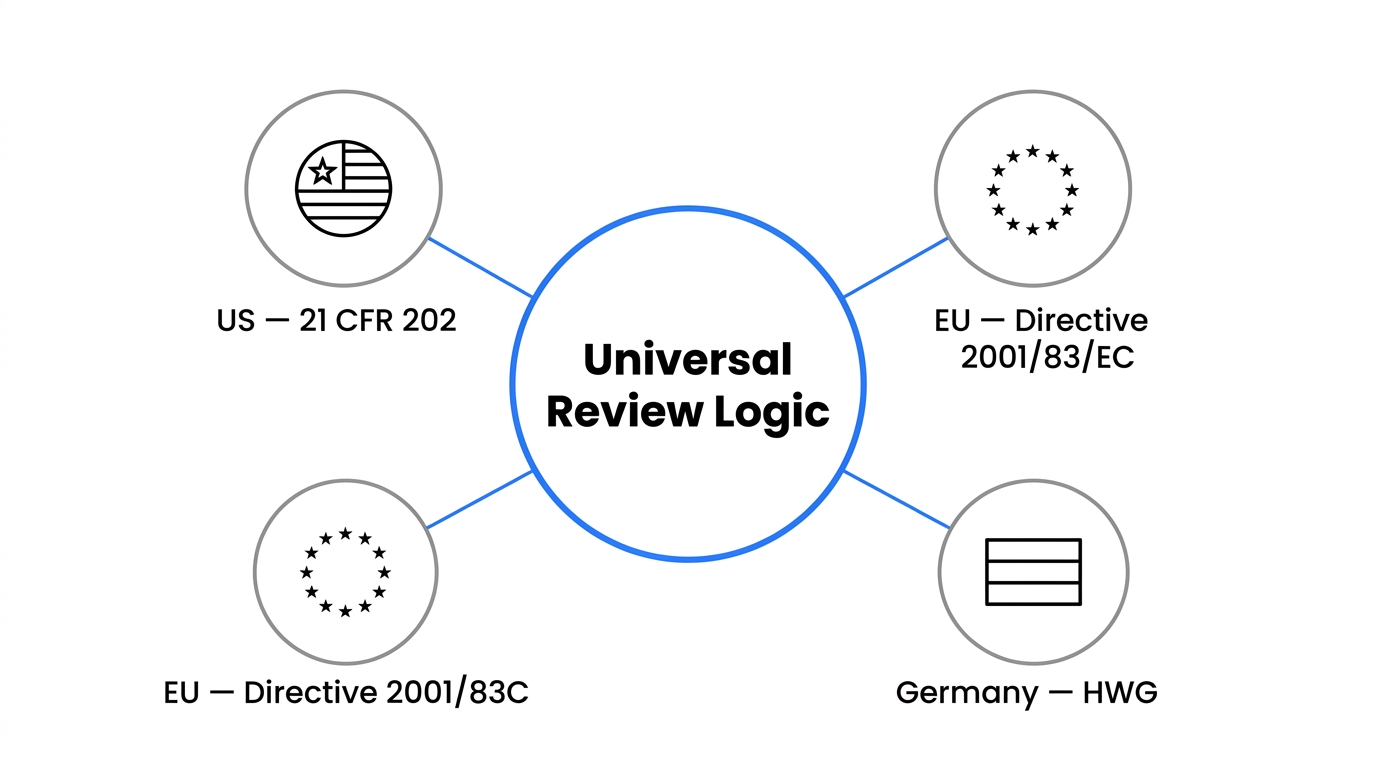
When your creative team designs a global campaign, maintaining distinct regional iterations becomes an operational burden. Establishing a standardized central repository for pre-vetted claims and layout components helps mitigate this friction. While the specific thresholds and mandatory statements change by market, the underlying review structure is identical. An effective international framework relies on a universal review logic:
- Verify and document every clinical claim.
- Ensure a clear and prominent balance of benefits and risks.
- Respect regional audience and channel restrictions.
By using a single global framework and swapping in local rules per campaign, international marketing teams can standardize their pre-review processes without duplicating effort.
Accelerate Approvals with This Marketing Compliance Checklist
To pass clinical review without delay, your promotional assets must be evaluated through three essential lenses before formal submission:
- Regulatory Lens: Confirms the correct regional framework applies (such as 21 CFR Part 202 or Directive 2001/83/EC) and verifies fair balance.
- Medical Lens: Ensures every clinical claim is backed by neutral, peer-reviewed evidence.
- Quality Lens: Assesses layout and copy readability, ensuring mandatory risk texts remain fully legible within the final creative design.
Reviewing assets against these three angles during the design phase typically helps teams catch alignment and claim errors early. Companies that standardize this pre-submission process have reported cutting review cycle times by as much as 57%.3
Using an automated workflow platform can help keep these steps organized. To find out how automated pre-screening can help simplify your processes, you can book a demo with Caidera. By flagging potential layout and text issues before formal submission, Caidera typically assists teams in reducing MLR iteration cycles, helping compress approval timelines from weeks to hours in many cases.
Pre-Screening Framework
Marketing Compliance Checklist: Quick Reference
This is the same standardized protocol used to verify healthcare marketing assets before formal MLR review. Specific regional codes differ, but the underlying compliance logic is universal — apply these checks to any promotional asset before it leaves your desk.
Regulatory Lens
- Confirm the correct regional framework applies, such as 21 CFR Part 202, Directive 2001/83/EC, or HWG.
- Verify fair balance between therapeutic benefits and safety risks is maintained across the entire asset.
- Ensure all mandatory regulatory disclosures, prescribing information, and Important Safety Information are present.
- Gate prescription-only pharmaceutical claims strictly to verified healthcare professional channels.
- Align all promotional claims verbatim with the current approved product label or SmPC.
Medical Lens
- Map every clinical efficacy and safety claim directly to validated study data or the approved label.
- Avoid unsupported superlatives or superiority claims without robust head-to-head clinical trial data.
- Restrict quality-of-life and outcome claims strictly to pre-specified, studied trial endpoints.
- State target patient populations, study designs, and trial endpoints with absolute accuracy.
- Present all safety risks, side effects, and contraindications plainly and with equal prominence.
Quality Lens
- Verify risk text, safety footnotes, and references remain fully legible at the final asset size.
- Limit promotional assets to one core educational message to ensure absolute clarity.
Download the Marketing Compliance Checklist to prepare your assets for a first-time-right review. Download the checklist →
Lens 1: The Regulatory Lens — Scope, Fair Balance, and Risk Disclosures
The regulatory lens defines the baseline legal boundaries of your promotional material. It forces marketing teams to verify that their assets align strictly with regional labeling laws and approved indications. Failing to balance risk and benefit information remains the primary driver behind modern regulatory warnings.
Verify the following parameters for every campaign asset:
- Regulatory Scope: Confirm which regional legal framework applies to your target market. In the US, promotional assets must align with § 202.1 of 21 CFR Part 202, while EU campaigns must follow Title VIII of Directive 2001/83/EC.
- Fair Balance: Present benefit and risk details with equal visual prominence, font size, and layout weight. The omission or minimization of risk information in consumer-directed creative was the most heavily penalized violation in recent enforcement actions.
- Mandatory Elements: Ensure the specific product indication, Important Safety Information (ISI), and all required legal disclosures are fully embedded in the layout.
- Audience and Channel Gating: Verify that prescription drug (Rx) claims are locked behind secure gates on public-facing channels, restricting visibility to healthcare professionals (HCPs) only.
- Label Alignment: Ensure all promotional claims match the approved, current version of the product label, with no mention of unapproved uses or off-label populations.
Lens 2: The Medical Lens — Scientific Backing and Claim Integrity
Medical review protects your brand from clinical overreach and unsubstantiated claims. Every promotional statement regarding efficacy or safety must reflect the exact scientific findings of your clinical trials.
Verify these evidence parameters before submitting your assets:
- Clinical Substantiation: Every efficacy claim must map directly to peer-reviewed clinical trials or the approved product label. Do not state or imply clinical outcomes that are not backed by hard data.
- No Unsupported Superlatives: Avoid comparative language like "best-in-class" or "superior" unless head-to-head clinical trial data support it. Classification claims like "first-in-class" carry a different bar: they must be factually accurate, not clinically substantiated against a competitor.
- Accurate Benefit Framing: Do not promise general quality-of-life improvements unless those specific endpoints were primary or secondary objectives in your clinical studies.
- Demographic and Context Integrity: State the exact patient population studied, including clinical endpoints and statistical significance. Do not apply observational study findings to broader patient groups.
- Risk and Side Effect Accuracy: State all safety findings, adverse events, and contraindications clearly. Never downplay side effects or frame risks as minor.
Lens 3: The Quality Lens — Design, Readability, and Layout Integrity
The quality review bridges the gap between marketing creativity and clinical rigour. Even if your clinical claims are completely accurate, poorly designed creatives can still fail regulatory audits if risk disclosures are difficult to read.
Verify these visual and textual parameters before submitting your assets:
- Visual Legibility: Ensure all mandatory risk disclosures, including the safety information, are clearly legible in the final layout, especially in small social media or video formats.
- Clarity of Message: Keep your campaign creative focused on one primary message rather than trying to present multiple competing ideas.
- Audience Tone: Tailor the language and terminology specifically for your targeted audience, avoiding complex medical jargon in patient-facing materials.
- Brand Consistency: Verify that all images, graphics, headlines, and call-to-action buttons align with your approved core claims and brand voice guidelines.
- Call-to-Action Compliance: Confirm that the call to action remains compliant with regional platform rules, without offering direct-to-consumer incentives where prohibited.
A minor design oversight, such as placing mandatory safety text in low-contrast boxes, can cause an immediate MLR rejection. True promotional quality means integrating compliant regulatory structures directly into the creative direction from day one.
How to Apply the Compliance Review Process
Implementing this checklist requires a structured, two-stage review process. Splitting the compliance evaluation between creative development and formal review typically prevents late-stage asset rejections.
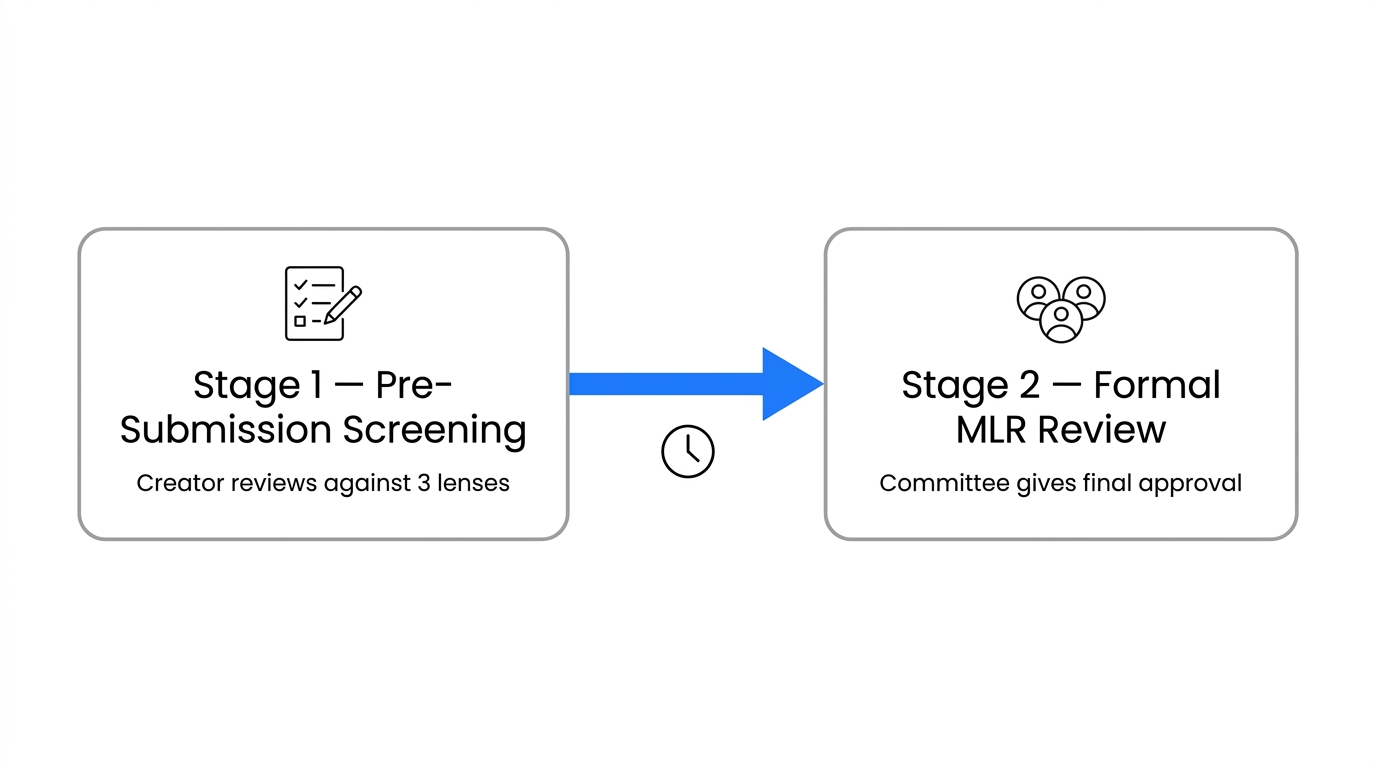
- Stage 1: Pre-Submission Screening: The content creator reviews the asset against all three lenses during drafting. Catching risk imbalances or clinical claim errors early typically saves days of rework before submission.
- Stage 2: Formal Review: The medical, legal, and regulatory committee evaluates the creative alongside its medical reference pack. Having the pre-screened documentation ready simplifies the final approval step.
For further operational strategies, read about reducing MLR bottleneck delays or explore the complete guide to MLR review.
If you want to move this checklist out of a spreadsheet and into something that runs automatically, book a call with Caidera to see how it fits your content workflow.
Sources
1 King & Spalding, "2025 Year in Review: FDA Drug and Device Advertising and Promotion Enforcement"
2 U.S. Department of Justice, press release on the GlaxoSmithKline $3B settlement; CDR News, on the Eli Lilly $1.4B comparison
3 Improvado, "MLR Review Process: A Complete Guide for Life Sciences Marketing" on average review cycle length (15–45 days per asset); EY Aqurance, "The State of MLR Review: Efficiency Trends & Best Practices" on the 57% reduction in review cycle times achieved by companies with optimized workflows
4 Deutsches Ärzteblatt and anwalt.de on typical dispute values and cost patterns for competitor cease-and-desist warnings under German advertising law: a representative range, not a single confirmed average.