
What Is a Promotional Review Committee (PRC)? Roles, Process and Best Practices


In September 2025, the FDA issued more than 50 warning and untitled letters over promotional claims in a single month1. In the eight months before that, it had issued five. Television ads, websites, social media videos, congress panels, newsletters: every content type a marketing team produces was on the list. Now, European authorities are also tightening in parallel.
Here is the uncomfortable detail: every one of those flagged assets had passed somebody's internal review. The business damage that follows is rarely limited to a fine: settlements for improper drug promotion have reached into the billions, flagged campaigns are pulled mid-flight and the spend behind them written off, and promotional programmes freeze for months while legal reviews every asset in the library. Which raises the question every life sciences marketer, medical affairs lead, and compliance officer should be able to answer: who in your company decides whether a promotional claim ships, and how good is that process under pressure?
That team is the promotional review committee (PRC): the cross-functional group, typically drawn from Medical, Legal, and Regulatory, that approves every piece of promotional content before it reaches a healthcare professional, a patient, or the public. Depending on the organisation, you may know the underlying review process as MLR review, which we cover in depth in our complete guide to MLR review. This article focuses on the committee itself: who sits on it, how it operates, where it breaks down in practice, and the best practices that separate committees that enable marketing from committees that block it, in the US and in Europe.
What Is a Promotional Review Committee?
PRC Definition
A promotional review committee is a specialised, multi-disciplinary team responsible for reviewing and approving all regulated promotional content before it is distributed to healthcare professionals, patients, or the public. ProPharma Group describes the PRC as the gatekeeper of advertising and promotional review, and that is exactly the right mental model: nothing promotional leaves the building without its sign-off.
The committee sits at the centre of the content approval process in every regulated life sciences company. Whether the asset is a sales aid, a congress poster, a product website, an email campaign, or a social media post, if it makes a claim about a regulated product, it passes through the PRC first.
Why PRCs Exist
Promotional material in life sciences is among the most closely scrutinised content in any industry, and the scrutiny comes from more than one direction.
In the United States, the FDA's Office of Prescription Drug Promotion (OPDP) actively monitors promotional communications and takes enforcement action when claims are misleading, unbalanced, or inconsistent with approved labelling under 21 CFR Part 202. The September 2025 enforcement wave described above was unprecedented in scale, and the downstream risks go further: legal exposure under the False Claims Act, reputational damage, and frozen promotional programmes while remediation runs. The five largest US settlements for improper drug advertising alone total over 10 billion dollars2.
In Europe, the picture is decentralised but no less strict. The European Medicines Agency (EMA), the European counterpart to the FDA, oversees the authorisation of medicines EU-wide, while the supervision of promotional practice runs through Directive 2001/83/EC and national law in each member state. Germany's Heilmittelwerbegesetz (HWG) is a prime example, with prohibitions enforced not only by authorities but by competitors through cease-and-desist actions. Industry self-regulation adds a further layer: the EFPIA Code in Europe, national codes such as the UK's ABPI Code with its PMCPA case system, and the IFPMA Code globally. A claim that is compliant in one market can be a violation in the neighbouring one.
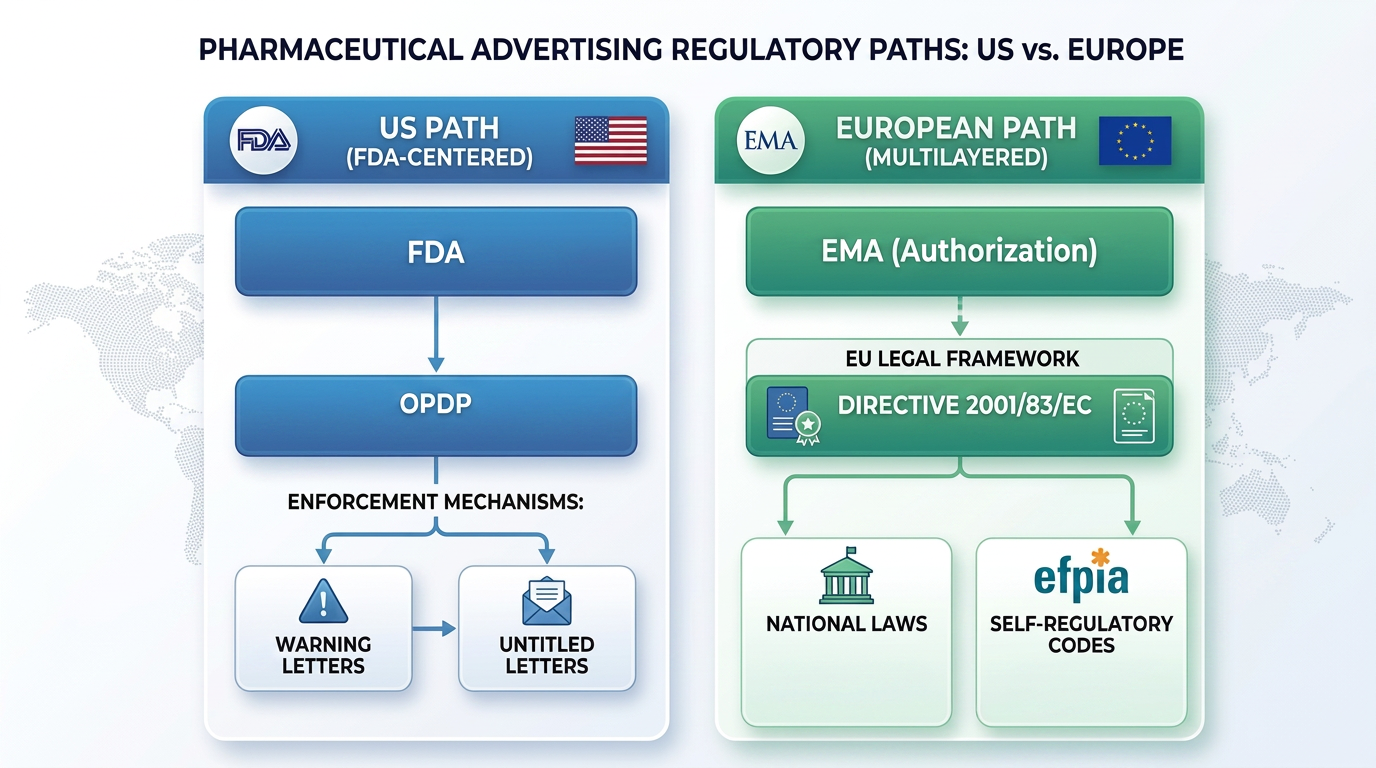
For a globally operating company, the PRC is the single control point where all of these regimes converge on one asset.
Practical takeaway: the PRC is not bureaucratic overhead. It is the control that stands between your campaign and an enforcement letter, whether that letter comes from the FDA, a national authority, or a competitor's law firm. Treat investment in its speed and quality as risk management.
Who Sits on a Promotional Review Committee?
The standard structure is a trifecta of three reviewers, three different risk lenses, one asset.
| Role | Typical background | What they check |
|---|---|---|
| Medical Reviewer | MD, PharmD, or PhD | Scientific accuracy, consistency with labelling, fair balance |
| Legal Reviewer | Attorney (in-house or external) | Laws, regulations, comparative claims, liability exposure |
| Regulatory Reviewer | Regulatory Affairs professional | Alignment with approved indications, mandatory statements, enforcement trends |
| Extended members (optional) | Commercial, Medical Affairs, outside counsel, country compliance officers | Context-specific and market-specific risk |
The Medical Reviewer
The medical reviewer is typically credentialled with an MD, PharmD, or PhD. Their responsibility is the scientific integrity of every claim: is it consistent with approved labelling and published clinical data, and is fair balance maintained between benefit and risk statements? If a claim relies on an exploratory endpoint rather than a pre-specified, validated analysis, this is the reviewer who catches it. Recent FDA enforcement has focused heavily on exactly this pattern, particularly for health-related quality of life claims.
Practical takeaway: give your medical reviewer the full reference pack, not just the asset. A claim they can trace to its source in one click gets approved in one round.
The Legal Reviewer
The legal reviewer checks materials against all relevant laws, regulations, industry standards, and company policies. In practice this covers comparative claims, warranty language, endorsements, testimonials, and false advertising exposure. In European markets, this is also the lens that watches competitor litigation risk: in Germany, for example, a substantial share of advertising enforcement arrives as a competitor's cease-and-desist letter rather than a regulator's notice. Legal review protects the company where medical review protects the claim.
Practical takeaway: flag comparative claims and endorsements for legal attention at the concept stage, before creative production begins. These are the two categories legal reviewers reject most often, and the most expensive to rework late.
The Regulatory Reviewer
The regulatory reviewer evaluates the promotional strategy for regulatory risk: do claims align with the approved indication, are all mandatory statements and disclaimers present and correctly formatted for the target market, and does the material reflect current enforcement trends? Strong regulatory reviewers actively monitor recent OPDP activity, national authority decisions, and self-regulatory case reports such as PMCPA rulings, and feed them back into the review standard, so the committee's bar moves with the regulators'.
Practical takeaway: ask your regulatory reviewer to brief the marketing team quarterly on new enforcement actions in your key markets. Thirty minutes of shared context prevents entire categories of rejected submissions.
Extended and Market-Specific Members
Medical, Legal, Regulatory is the core, but many committees add representatives from Commercial or Marketing, Medical Affairs, and outside counsel for complex or high-risk materials. Some European jurisdictions add formally designated roles: in Germany, §74a of the Medicines Act (AMG) requires pharmaceutical companies to appoint an information officer (Informationsbeauftragter) who bears personal responsibility for promotional material, and in the UK, ABPI Code signatories certify materials through nominated final signatories. The right committee size is the smallest one that covers the actual risk of the asset and the markets it will run in. Every additional mandatory reviewer adds cycle time; add members per asset class and market, not permanently.
Practical takeaway: map each reviewer to a distinct risk lens. If two members review the same risk, you have redundancy. If no member owns a risk, and market-specific rules are the risk most often left unowned, you have exposure. We have curated an in-depth marketing compliance checklist in this article. It provides a standardized protocol used to verify healthcare marketing assets before formal MLR review.
How a PRC Operates
From the committee's perspective, the prc process is an operating rhythm: a structured intake, a review, a decision, and an archive.
- Intake: the content team submits the asset with a reference pack supporting every claim. Intake quality is the single biggest lever on total cycle time; many committees refuse unlinked submissions outright.
- Review: Medical, Legal, and Regulatory assess the asset, sequentially or in parallel, and consolidate feedback.
- Decision: approve, approve with changes, or reject with reasons. Mature committees also define an escalation path for deadlocks, so one disagreement cannot freeze an asset indefinitely.
- Approval and archive: the approved version is locked, and a complete audit trail of versions, comments, approvals, and timestamps is retained for inspection readiness, together with an expiry date so content based on superseded labelling is pulled in time.
How long this takes, which stages consume the most calendar time, and what benchmark cycle times look like by company size is the subject of its own deep dive: our complete MLR review guide covers the process stage by stage. The short version: in organisations without structured systems, review cycles for complex materials stretch to multiple weeks per round, and the revision loop, not the review itself, is where most of the time disappears.
Practical takeaway: measure your committee's cycle time per stage, not just end to end. Most teams discover the delay is not the review itself but the queue in front of it and the revision loops after it.
The fastest way to shorten those loops is to catch issues before intake. See how Caidera automates pre-submission compliance checks.
Where PRC Reviews Break Down in Practice
The failure patterns below appear in almost every organisation at some point, in US and European teams alike. They are not signs of incompetent reviewers or careless marketers. They emerge at the intersection of time pressure, unclear ownership, and processes that rely on email instead of systems.
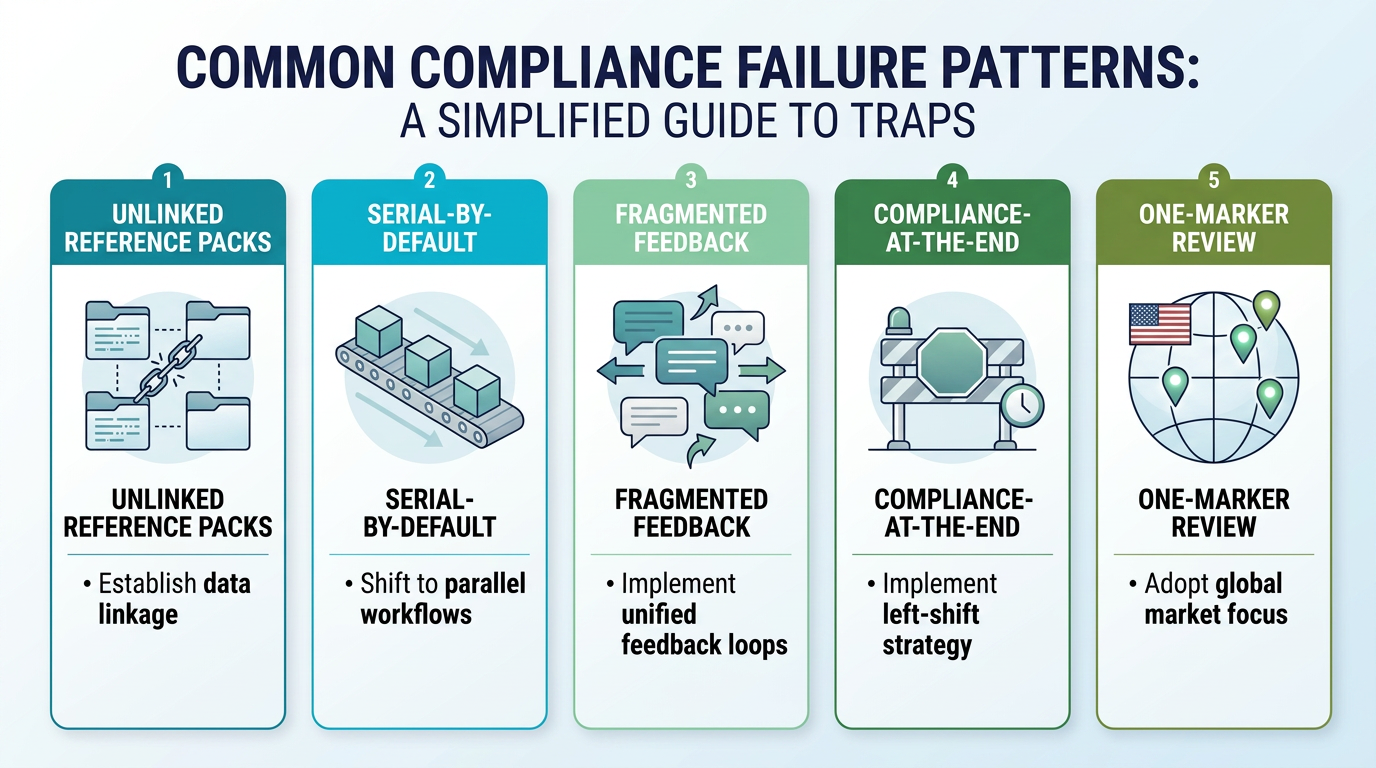
Failure 1: Incomplete reference packs. A draft lands in the queue without each claim tied to a highlighted line in its source document. The reviewer either does the forensic work themselves, which multiplies their time per asset, or sends it back unreviewed. Either way, a week is gone before substantive review begins.
Failure 2: Sequential review by default. Medical reviews first, then Legal, then Regulatory, each waiting for the previous sign-off. No regulation requires this, in any market. It usually persists because feedback lives in email threads and nobody trusts that all reviewers are seeing the same version.
Failure 3: Fragmented feedback across versions. Comments arrive by email against version 3 while the team is already editing version 4. Contradictory guidance between reviewers goes unresolved, and the content team plays referee between functions that never spoke to each other.
Failure 4: The committee as a bottleneck of last resort. Compliance is checked only at the end of the content process, when copy, design, and campaign timing are already locked. Errors found at this point are the most expensive kind: fixing them means restructuring a finished asset and re-entering the queue.
Failure 5: One-market review for multi-market content. An asset approved under US rules is rolled out in Europe, or a German asset is translated without re-checking the wording against local requirements. The claim did not change, but the applicable law did. This failure is invisible until a national authority, or a competitor, notices.
Practical takeaway: audit your last ten reviewed assets against these five patterns. The pattern that appears most often is where your next process investment should go.
PRC Best Practices
These four practices are how high-performing committees run promotional compliance as a system rather than a heroic effort, and each one attacks a specific failure pattern from the previous section.
Define Roles, Responsibilities, and Escalation Clearly
When each function knows exactly what it is responsible for, collaboration improves and conflict decreases. Document who reviews which risk, who breaks ties, and under which criteria, including who owns market-specific requirements for each country the content will run in.
Treat the PRC as a Service Function
The committee provides a service to the marketing organisation. Applying service operations principles produces more predictable outcomes: defined SLAs per material tier, predictable turnaround times, structured intake requirements, and published queue status. When marketing can plan around a reliable ten-day review instead of an unpredictable multi-week one, campaign timelines stop slipping.
Run Pre-Submission Checks Before Committee Intake
The most expensive revision is one that restructures a nearly finished asset. Introducing a compliance pre-check before content enters the formal queue, whether a structured manual checklist or an AI-assisted review, typically reduces revision rounds and shortens total cycle time. The logic is simple: every issue caught at the point of creation costs minutes; the same issue caught in review round two costs weeks. A structured starting point is our marketing compliance checklist, which covers the checks to run before every submission.
Whether your committee can shift from sequential to parallel review, and what that takes in practice, is covered in our complete guide to MLR review.
Practical takeaway: pick one practice and implement it this quarter. Pre-submission checks usually deliver the fastest measurable improvement because they attack the revision loop, which is where most cycle time is lost.
PRC vs. MLR Review: What Is the Difference?
The short answer: PRC describes the committee, MLR describes the disciplines. A promotional review committee is the organisational structure, the standing team with defined membership, decision rights, and meeting cadence. Medical, Legal, Regulatory describes the three functions doing the reviewing inside it.
| Term | What it refers to | Typical usage |
|---|---|---|
| PRC | The committee (the who) | "The PRC meets every Tuesday" |
| MLR review | The review process and disciplines (the what) | "This asset is in review" |
| CMLR | MLR plus a Commercial representative | Larger organisations |
| Promotional review | Umbrella term for the whole activity | Interchangeable with both |
Some organisations maintain the distinction precisely; many use the terms as synonyms. Both usages are common and neither is wrong. What actually determines outcomes is whether the process behind the label is structured, documented, and consistently applied, regardless of what it is called. For the process side, including stage-by-stage mechanics, cycle time benchmarks, and the most common bottlenecks, read our complete guide to MLR review.
Practical takeaway: align on terminology once, write it into your SOP, and move on. Companies lose real time in cross-functional meetings re-litigating vocabulary that has no regulatory significance.
Automating Pre-Submission Checks with AI
The pattern across every section above is the same: the biggest time savings in promotional review happen before the committee ever sees the asset. Complete reference packs, pre-checked claims, present disclaimers, market-specific wording, and clean versioning turn a six-round review into a two-round review. The question is how to make that pre-submission quality systematic rather than dependent on individual diligence.
This is where Caidera fits. The platform is built for marketing teams in healthcare and life sciences and can help anchor compliance checks structurally earlier in the content process, before assets enter the formal committee queue.
AI-Powered Compliance
What Caidera Can Typically Support in Practice
- Automated pre-checking of content claims against defined rule sets, including approved indications, mandatory statements, and fair balance requirements, while the content is being created
- Market- and audience-specific review paths, so the same claim is evaluated differently for HCP communication and public channels, and against the requirements of different jurisdictions such as HWG or FDA rules
- Early risk signals, such as off-label references or missing mandatory statements, surfaced in most cases before the asset reaches the committee
- Structured approval workflows that document which content was checked, under which conditions, creating traceability for Regulatory Affairs and Legal
Caidera does not replace review by qualified professionals, and final decision authority always remains with your committee. What the platform can typically deliver is a shorter distance between content creation and the first compliance signal, so your reviewers concentrate on genuinely critical judgment calls instead of hunting for missing references. Teams working with AI-supported pre-checks report significantly shorter cycle times and less time spent in review meetings.
See how Caidera pre-verifies your content before it ever reaches your promotional review committee: explore the Caidera platform →
Or talk it through with us directly: book a call and we will walk through the process with your own content examples.