
EmpCo Directive: Sustainability Claims in Product Marketing from 27 September 2026


From 27 September 2026, new EU rules govern how you may advertise with environmental and sustainability arguments, and the Directive provides no blanket sell-off period for stock that is already labelled1. Whatever is in market on that date has to comply.
Enforcement usually starts with a competitor or a consumer association challenging the claim. Where it is printed on packaging, relabelling or a recall follows, and those costs regularly exceed the legal penalty itself. Where infringements are widespread, coordinated EU enforcement can reach fines of up to 4 % of annual turnover2.
Terms like “environmentally friendly” or “climate neutral” can become impermissible when the supporting evidence is missing or sits in the wrong place. A green leaf symbol on the pack falls under the same rules, because the new definition covers imagery as well as text. The rules reach packaging, websites, brochures, product pages and social media.
Claims of this kind could already be challenged under existing law. What changes in September is the standard of proof. Specific practices now sit on a statutory black list, which makes them impermissible without any further case-by-case assessment3. For those, no amount of evidence will save the claim.
Two things are regularly confused:
- The EmpCo Directive is EU law: Directive (EU) 2024/825, formally “Empowering Consumers for the Green Transition”. It amends the Unfair Commercial Practices Directive and sets what changes about environmental claims.
- Your national statute is what advertising is actually judged against. Every member state implements EmpCo in its own law, usually by amending existing unfair competition or consumer protection rules.
EmpCo does not create a separate statute you can look up. Its requirements enter national law by amending rules that are already in force. Sustainability claims continue to be judged under national unfair competition law, now against new definitions and specific prohibitions4. If you are looking for an “EmpCo Act”, you will not find one. Look in Annex I of the Unfair Commercial Practices Directive, then in your own national statute.
EmpCo does not ban sustainability communication. It requires claims to be specific, substantiated, and clear about their scope.
What EmpCo changes, and where to look for it
The EmpCo Directive is Directive (EU) 2024/825 of 28 February 2024. It amends two existing directives: the Unfair Commercial Practices Directive (2005/29/EC) and the Consumer Rights Directive (2011/83/EU)5.
Member states had to adopt implementing measures by 27 March 2026. They apply those measures from 27 September 20266. Those are two different dates, which is why a national law that has already been published still does not apply until September.
Three things change for marketing teams.
First, the law now defines what counts as an environmental claim. The definition is wide. It covers text, images, symbols, brand names and product names7. A green leaf on a carton is a claim. So is a product called “EcoPure”.
Second, four practices become banned outright. They join a list of practices that are unfair in every case3. For these there is no weighing of context, and no evidence will rescue the claim. Calling a product climate neutral because you bought carbon credits is one of them.
Third, promises about the future need a plan behind them. “Climate neutral by 2030” on a pack, with nothing published to show how you get there, becomes misleading.
All of this comes from an EU directive. A directive is an instruction to governments, not a rule you follow directly. Every member state writes it into its own law, so the substance is the same across the EU. What differs is where you find it: a different statute name and section number in each country. In a dispute you cite your national law, not the Directive4.
Which claims are affected
1. Vague green words (generic environmental claims)
Words like “environmentally friendly”, “eco”, “green” and “climate friendly” say nothing specific on their own. From September you may use them only if the product holds a recognised top environmental rating: an EU Ecolabel, an official Type I ecolabel, or an equivalent under other EU law8. Very few products have one.
A claim counts as vague when you do not explain what you mean, clearly, on the same medium7. The ban is absolute: “making a generic environmental claim for which the trader is not able to demonstrate recognised excellent environmental performance relevant to the claim” (point 4a)3.
The way out is to swap the vague word for the specific fact. “Environmentally friendly packaging” becomes “packaging made from 90 % recycled paper”.
2. Claims that cover more than they should
Your carton is made of recycled board. The product inside is not. If the pack says “sustainably produced”, a shopper reads that as the whole thing, and that is now banned3.
The rule covers “making an environmental claim about the entire product or the trader’s entire business when it concerns only a certain aspect of the product or a specific activity of the trader’s business” (point 4b)3.
Say which part you mean. “Folding carton made from 80 % recycled material” is safe. “Sustainably produced” across the front of the pack is not.
3. Carbon neutrality based on offsetting
If you buy carbon credits and then call the product climate neutral, that is banned from September. The same applies to “climate neutral shipping” and “CO2-neutral delivery”.
The rule bans “claiming, based on the offsetting of greenhouse gas emissions, that a product has a neutral, reduced or positive impact on the environment in terms of greenhouse gas emissions” (point 4c)3. Documentation will not save it. The offsetting itself is the problem.
You may still tell people which climate projects you fund. You may not turn that into a neutrality claim about the product.
4. Your own sustainability labels
If your design team invented the badge, it probably has to come off. The rule bans “displaying a sustainability label that is not based on a certification scheme or not established by public authorities” (point 2a)3.
A label counts as a label whether it is public or private, and whatever you call it7. To qualify as a certification scheme, it needs open and fair entry terms, criteria built with outside experts, a way to withdraw the label from anyone who breaks the rules, and monitoring by a third party independent of both you and the scheme owner7. An in-house badge has none of that.
Watch the artwork as well as the wording. A design does not need the word “certified” to read as a seal. A green leaf next to the word “natural” can be enough.
5. Promises about future environmental performance
“Climate neutral by 2030” is still allowed. It just needs a real plan behind it, and the bar is high.
The plan has to set measurable targets with dates, name the resources behind them, and be checked regularly by an independent expert whose findings you publish9. In the words of the rule, a claim is misleading “without clear, objective, publicly available and verifiable commitments set out in a detailed and realistic implementation plan”9.
This one sits outside the black list, so a court weighs the circumstances9. Without the plan, though, the claim is open to challenge wherever it appears: on the pack, or in the sustainability section of your website.
Overview: risky claims and more precise wording
| Claim | Classification | Possible more precise wording (evidence required) |
|---|---|---|
| “Climate neutral production” (via offsetting) | Annex I, point 4c: prohibited regardless of evidence | “Production emissions cut by 30 % since 2022” |
| “Environmentally friendly packaging” | Annex I, point 4a: generic claim without recognised performance | “Packaging made from 90 % recycled paper” |
| “Sustainably produced” on the whole product | Annex I, point 4b: overreach where only one part qualifies | “Folding carton made from 80 % recycled material” |
| Your own “Eco Choice” logo | Annex I, point 2a: label with no certification scheme | Recognised Type I ecolabel, or no label at all |
| “Climate neutral by 2030” | Article 6(2)(d): future claim without a verified plan | Interim targets with dates, resources and external verification, publicly available |
| Green leaf plus “natural” on the pack | May count as an implicit environmental claim or as a label | Design without environmental suggestion, or substantiated specification |
What happens if you get it wrong
The usual route is civil. A competitor or a consumer association challenges the claim. The outcome is an undertaking to cease and a contractual penalty. Where the claim is printed on packaging, relabelling or a recall follows. Those costs regularly exceed the legal consequence itself.
Enforcement mechanisms differ by member state. In some, competitors and trade associations bring most challenges. In others, consumer protection authorities take the lead. The commercial exposure is similar either way.
The fine risk is often described too loosely. Penalties are set in national law, and the ceilings vary widely between member states2. The frequently quoted rate of 4 % of annual turnover applies only within a coordinated enforcement action under Regulation (EU) 2017/2394, and only to traders above a turnover threshold in the member state concerned2.
The practical takeaway: do not build your preparation around the 4 % scenario. Start with the claims already in market, on packaging and in live campaigns.
Practical examples: food, cosmetics, medtech, OTC
EmpCo applies across sectors. The review becomes complex where a second body of rules already governs product claims. Both layers then have to be handled in the same approval process.
Food and food supplements
This is where national case law has gone furthest. In a judgment of 27 June 2024, Germany’s Federal Court of Justice held that advertising a confectionery product as climate neutral was misleading (case I ZR 98/23)10. The term is ambiguous: it can mean avoidance or offsetting. The advertisement itself therefore has to explain which is meant, and a reference to the website was not enough for the court.
Food supplements add a second review. The health-related part of a claim falls under the Health Claims Regulation (EC) No 1924/200611. The environmental part falls under the new rules from September 2026. A product advertised with “sustainably sourced ingredients” and a green leaf symbol needs matching evidence and a documented approval path for both layers.
Cosmetics and personal care
The density of environmental claims is especially high in this category: “natural”, “vegan”, “plastic free”, refill systems, green colour palettes and leaf symbols. The new definition of an environmental claim expressly covers images and symbols7.
Volume is what makes this expensive. Hundreds of SKUs, several language versions and long production lead times make changes expensive. Packaging designs going to print now will already be in market on the deadline. Because the Directive contains no blanket sell-off period for goods already labelled1, the new rules also apply to stock that is already on shelves.
A second body of rules applies here too. Claims for cosmetic products fall under Article 20 of the EU Cosmetics Regulation (EC) No 1223/2009, supplemented by the Common Criteria Regulation (EU) No 655/2013. Its Article 2 requires that claims be consistent with the documentation in the product information file12. The evidence has to exist at the time of the claim, and it has to match the specific claim.
“Free from” statements are particularly relevant for sustainability claims, and the guidelines to the Common Criteria set out their own tests12. “Free from microplastics” therefore has to be substantiated twice: under cosmetics law, and, as soon as an environmental benefit is inferred from it, under the new rules.
Medical devices
For medical devices, Article 7 of the EU Medical Device Regulation prohibits misleading statements. It applies only to claims about the intended purpose, safety and performance of the device13. Environmental claims fall outside it.
Teams selling consumer-facing devices, such as plasters, thermometers, supports or hearing aids, have an established review path for performance claims through the MDR. For “recyclable packaging” on the same box there was no comparable path. That path has to be defined before 27 September 2026.
OTC pharma and consumer health
The consumer-facing side is what is affected: OTC products and consumer health, including packaging, product pages and campaign material. Prescription medicines and communication aimed at healthcare professionals fall largely outside the business-to-consumer scope.
A claim on an OTC pack has to satisfy national medicines advertising law. As soon as it carries an environmental element, the new requirements apply on top. “Environmentally friendly blister packaging” raises no issue under medicines advertising law, yet is still open to challenge from September 2026. In many teams this second review is not yet carried out systematically.
Teams usually know both sets of rules. Their approval process only covers one of them. A manual review works when there is little content, but across many assets, markets and language versions it no longer scales.
In practice: prioritise by production lead time, not by revenue. For packaging going to print now, the compliance question is decided today.
Still checking environmental claims by hand? See how Caidera checks claims against stored rule sets and your own reference library, before they go into the approval round. Book a demo →
What marketing leads should prepare now
Preparation starts with an inventory. In practice, briefings, drafts, evidence, language versions and approvals are scattered across different tools. Claims get adapted for new formats, sources stay behind somewhere else, and the compliance review starts shortly before publication. That is exactly when gaps become expensive.
- Inventory. Capture every consumer-facing claim with an environmental element: packaging, website, product data sheets, advertising, point-of-sale material and social media. Include imagery, colours, symbols and product names.
- Classify each claim. Is it generic or specified? Does it rest on offsetting? Does it refer to the whole product or only to part of it? Does it concern the present or the future?
- Secure the evidence. Every claim needs matching evidence at the time of the communication: ecolabels, life-cycle assessments, test reports or certification documents. The evidence has to match the specific claim and be current at the time of use.
- Check every label. For each mark, establish whether it rests on a certification scheme. Then decide what stays, what is adapted and what comes off.
- Define the approval path. Decide who approves environmental claims, and where that decision is documented.
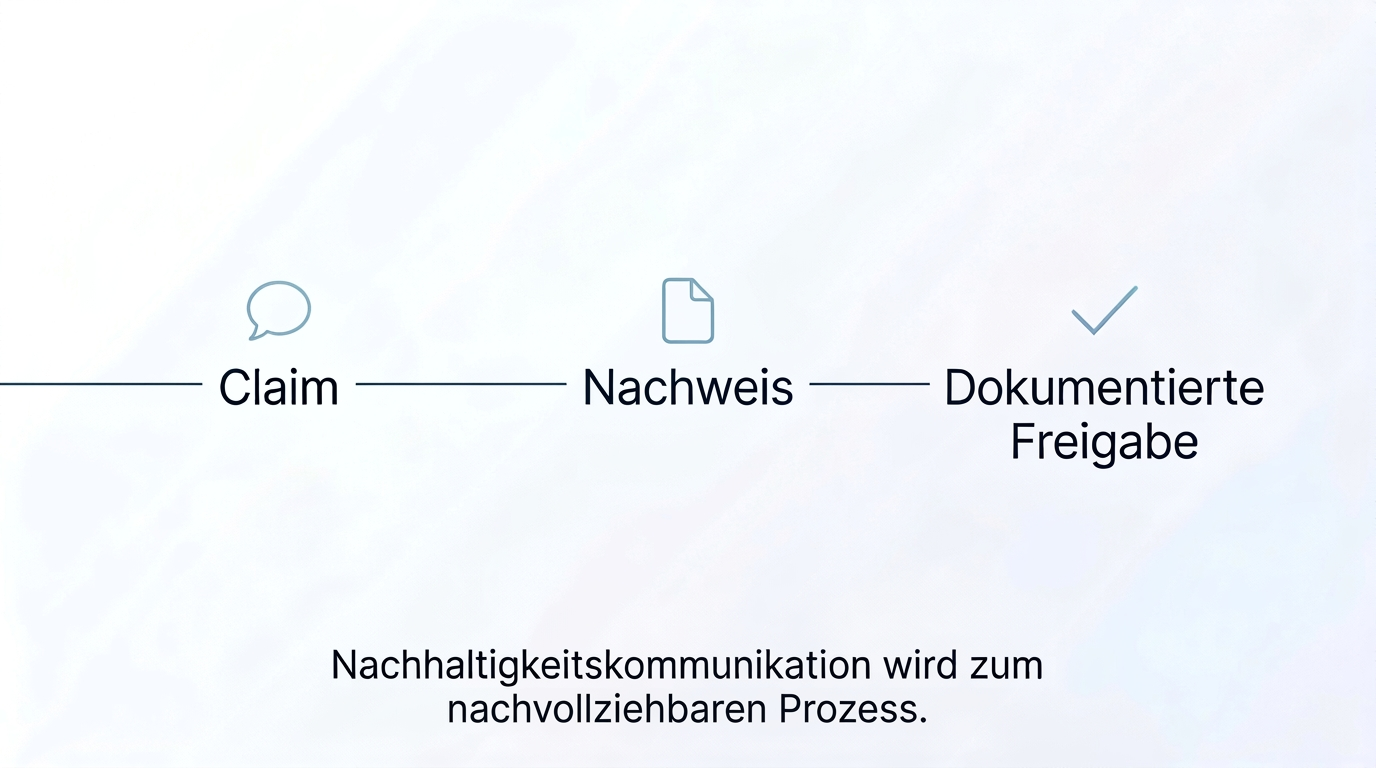
The last point is regularly underestimated. If a claim is challenged later, what counts is not only whether evidence exists. You also have to be able to trace which evidence belonged to which claim, and who granted the approval. In teams with several markets and language versions, that mapping is often the weak point.
The step to get right: name one person who gives final approval on environmental claims. Then record where the decision and the matching evidence are documented.
How creation, review, evidence and approval fit together
The effort rarely comes from a single claim. It comes from the handovers. Briefings sit in a project tool, sources on shared drives, drafts in documents or AI chats, and approvals in email threads. With every language and every format, the risk grows that a specification is missing or an older version gets reused. If the compliance review only starts at the end, the team has to make changes under time pressure.
The five preparation steps can be worked through manually. They only become repeatable once they run in a shared workflow.
| Step | Manual | System-supported |
|---|---|---|
| Inventory | Searching drives and the DAM | Assets with claim relevance captured systematically |
| Classification per claim | Individual assessment by compliance | Automated pre-check against stored rule sets |
| Securing evidence | Separate evidence storage | Check against the reference library, findings linked to the rule |
| Checking labels | Manual research per mark | Own rule per permitted mark, stored once |
| Approval path | Email chains, version confusion | Documented approval run with audit trail |
Caidera connects these steps for marketing teams in regulated industries. The Caidera Compliance Engine checks content against stored rules and your own reference library. The Content Studio supports creation across markets and languages. Review, sign-off and approval stay in one traceable process14. If you would like to see the process on your own content, talk to Caidera.
Consistency across languages and formats. In the Content Studio the same campaign is created across markets and languages, and runs through the Compliance Engine before team approval15. A specification that appears on the folding carton in one market cannot then disappear unnoticed in a cropped social format or another language version.
Checking before the approval round. Content is checked against the stored rules and your own reference library. Unsubstantiated claims are flagged. Every finding points back to the rule that triggered it.
One approval run instead of email chains. Draft, review and approval run in a single process. Every decision and every change is documented and exportable. You can always see who approved what, when, and on what basis.
For marketing teams, EmpCo creates an additional review layer. Product claims are already judged against a fixed body of rules. Environmental claims now sit beside them, with their own definitions, their own black list and their own evidence requirements. They appear on the same assets but are judged by different criteria.
Rule sets such as HWG, FSA, ABPI and FDA are preconfigured in Caidera14. For the new environmental-claim requirements there is no such standard rule set yet. They can be modelled through your own rules: define once what counts as a substantiated specification and which labels are permitted, then apply that to every asset in every market. Across a portfolio of hundreds of SKUs and several language versions, that is the difference between one decision and hundreds of individual assessments.
When a claim is challenged, having the evidence is not the hard part. You have to show which evidence belonged to which claim, and who approved it, sometimes years after the campaign ran. That record is what most teams are missing, and producing it is what Caidera was built for. If you do not have a system for it yet, get in touch.
The system does not replace legal assessment in the individual case. Legal, Medical and Regulatory keep their responsibility. A connected workflow makes sure those teams receive prepared work rather than starting from scattered raw material. How to set up such an approval run is described in our article on structured approval workflows.
Frequently asked questions about EmpCo
When does the EmpCo Directive start to apply?
The new provisions apply from 27 September 20266. Member states had to adopt implementing measures by 27 March 2026. A national act published before that date still does not apply until 27 September.
Is advertising with “climate neutral” completely banned from September 2026?
No. What is prohibited is the claim where it rests on the offsetting of greenhouse gas emissions (Annex I, point 4c)3. Genuinely emission-free production may still be described. You may also continue to report on climate protection projects you fund. That must not become a neutrality claim about the product.
Does EmpCo apply to business-to-business communication?
The new EmpCo provisions concern commercial practices towards consumers. National unfair competition law often applies in business-to-business contexts as well. In the Katjes proceedings the contested advertisement appeared in a food industry trade journal10, so the boundary is not always where teams expect it.
What is the difference between EmpCo and the Green Claims Directive?
EmpCo is adopted law and applies from 27 September 2026. The Green Claims Directive is a separate legislative proposal with additional substantiation and certification duties. Its path is open: the European Commission announced in June 2025 that it intended to withdraw the proposal, but no formal withdrawal has taken place16, and the official procedure file still lists it as ongoing17. Plan with EmpCo, not with the Green Claims Directive.
What happens to packaging already in market on 27 September 2026?
The Directive contains no blanket sell-off period for goods already labelled1. Proposals for one have been raised at national level, but none is in force. Check whether your own member state has provided any transitional arrangement.
Sources
1 The Directive contains no blanket sell-off period for goods already labelled. One national example: Germany’s Bundestag asked the federal government to press in Brussels for a sell-off period until 27 March 2027; that request is not applicable law · Bundestag printed paper 21/1855
2 Penalties are set in national law and ceilings vary between member states. Germany, for example, provides for an administrative fine of up to 50,000 euros (section 19 UWG). Within a coordinated enforcement action under Regulation (EU) 2017/2394, fines of up to 4 % of annual turnover apply to traders above a turnover threshold in the member state concerned · gesetze-im-internet.de, UWG · EUR-Lex, Regulation (EU) 2017/2394
3 New points 2a, 4a, 4b and 4c inserted into Annex I of Directive 2005/29/EC by Directive (EU) 2024/825. Annex I lists commercial practices that are unfair in all circumstances · EUR-Lex, Directive (EU) 2024/825, Annex · EUR-Lex, Directive 2005/29/EC
4 Example of national numbering: Germany’s Third Act amending the Act against Unfair Competition, promulgated 19 February 2026, places the four black-list entries in the annex to section 3(3) UWG and the future-performance rule in section 5(3) no. 4 UWG · buzer.de, Synopsis of the 3rd UWG Amendment Act
5 Directive (EU) 2024/825 of 28 February 2024 amending Directives 2005/29/EC and 2011/83/EU (“Empowering Consumers for the Green Transition”), in force since 26 March 2024 · EUR-Lex, Directive (EU) 2024/825
6 Article 4 of the Directive: member states adopt implementing measures by 27 March 2026 and apply them from 27 September 2026 · EUR-Lex, Directive (EU) 2024/825, Article 4
7 Definitions inserted into Article 2 of Directive 2005/29/EC: “environmental claim” (point o), “generic environmental claim” (point p), “sustainability label” (point q) and “certification scheme” (point r), including the four criteria a scheme must meet · EUR-Lex, Directive (EU) 2024/825, Article 1
8 “Recognised excellent environmental performance” (Article 2, point s): the EU Ecolabel under Regulation (EC) No 66/2010, officially recognised national or regional EN ISO 14024 Type I ecolabelling schemes, or top environmental performance under other applicable Union law · EUR-Lex, Regulation (EC) No 66/2010
9 New Article 6(2)(d) of Directive 2005/29/EC: environmental claims about future environmental performance require clear, objective, publicly available and verifiable commitments in a detailed and realistic implementation plan with measurable and time-bound targets and allocated resources, regularly verified by an independent third-party expert whose findings are made available to consumers · EUR-Lex, Directive (EU) 2024/825, Article 1
10 Germany’s Federal Court of Justice, judgment of 27 June 2024, case I ZR 98/23 (Katjes, on a climate neutrality claim): advertising with an ambiguous environmental term is permissible only if the advertisement itself explains the term; a reference to a website is not sufficient. The contested advertisement appeared in a food industry trade journal · dejure.org, BGH I ZR 98/23
11 Regulation (EC) No 1924/2006 on nutrition and health claims made on foods · EUR-Lex, Regulation (EC) No 1924/2006
12 Claims for cosmetic products: Article 20 of Regulation (EC) No 1223/2009, supplemented by the Common Criteria Regulation (EU) No 655/2013, whose Article 2 requires claims to be consistent with the documentation in the product information file · EUR-Lex, Regulation (EC) No 1223/2009 · EUR-Lex, Regulation (EU) No 655/2013
13 Regulation (EU) 2017/745 (MDR), Article 7: prohibition of misleading text, names, trade marks and images regarding the intended purpose, safety and performance of a device · EUR-Lex, Regulation (EU) 2017/745
14 Caidera Compliance Engine: preconfigured rule sets (HWG, FSA, ABPI, FDA), checking against your own reference library, documented and exportable approval trail · caidera.ai/product/compliance-engine
15 Caidera Content Studio: creating the same campaign across markets and languages · caidera.ai/product/content-studio
16 Green Claims Directive, status of the proposal: the European Commission announced on 20 June 2025 that it intended to withdraw the proposal; on 25 June 2025 it clarified that no formal withdrawal had taken place · Latham & Watkins, Commission announces intention to withdraw
17 Green Claims Directive: separate Commission proposal COM(2023) 166; legislative procedure 2023/0085(COD) still listed as ongoing on EUR-Lex (as at 18 August 2026) · EUR-Lex, procedure file 2023/0085(COD)
This is general information, not legal advice. Please review your specific case, ideally with your own legal counsel.