
Brand Compliance Software: From Scattered Marketing Content to a Consistent Brand


A campaign can look polished asset by asset and still feel inconsistent as a whole.
The landing page uses clean layouts and understated photography. The agency’s social posts introduce a different image style. The email sounds formal, while the brochure takes a conversational approach. Each contributor has made reasonable creative choices, but together the materials no longer feel like the same brand.
The problem can extend across campaigns. A new agency interprets the guidelines differently. A local team adapts an old template. Different writers develop their own versions of the company’s voice. Over time, the brand becomes harder to recognise consistently.
Resolving those differences takes work. Copy needs editing, images need replacing and finished layouts may need another design round. In regulated industries, changes to product statements or accompanying information can also require further specialist review.
Brand compliance software can help teams apply shared requirements throughout content creation and review. Its usefulness depends on how well it supports the elements that make a brand recognisable: visual identity, photography, tone of voice and messaging.
This article explains what that requires, how to evaluate the software and where human judgement remains essential. Practical scenarios are fictional unless identified as a customer case study.
At a glance
- The business problem: Content from different people, agencies and tools can drift in appearance, voice and message, both within a campaign and over time.
- The opportunity: Shared guidance, current assets and early checks can reduce repeated corrections while allowing appropriate creative variation.
- The boundary: Brand consistency, factual accuracy and legal compliance require different assessments. Passing one does not establish the others.
- The starting point: Test one campaign against a manageable set of visual and editorial requirements, then measure the work needed to reach approval.
What inconsistent marketing content costs the business
Different contributors often work from different starting points. One designer uses the current brand book. An agency follows the previous campaign. A writer relies on personal judgement because the tone-of-voice guidance contains broad adjectives but few examples.
These differences can affect several layers of the brand:
| Area | How inconsistency can appear |
|---|---|
| Design | Different typography, colour use, spacing or layout conventions |
| Photography and imagery | Conflicting approaches to subjects, lighting, cropping, illustration or image treatment |
| Writing style | Changes in formality, sentence structure, terminology or how the audience is addressed |
| Messaging | Different descriptions of the same product, benefit or company positioning |
| Continuity across campaigns | Each campaign introduces a new interpretation of the brand without a deliberate decision to change it |
AI can add to this variation when people generate content using different instructions or reference material. The underlying coordination problem also exists in content created entirely by people.
Rework spreads across formats
Imagine a campaign whose social graphics use a photographic style that conflicts with the website and brochure. If the issue is discovered after all formats have been produced, correcting it may involve new image selection, layout changes and another round of feedback.
Writing inconsistencies can have a similar effect. A tone correction identified in the main campaign asset may need to be applied to emails, landing pages and local adaptations.
The relevant measure is the total effort required to reach approved content, including the corrections that happen after the first draft or design.
Reviewers repeat the same feedback
A brand lead should not have to explain the same image treatment or tone-of-voice preference separately to every contributor.
When recurring feedback remains in emails and comment threads, the next campaign can repeat the same mistakes. Guidance becomes more useful when those decisions are translated into clear examples, maintained templates and requirements people can apply before submitting their work.
Early checks can help identify routine deviations so reviewers have more time for creative quality and substantive decisions.
Customers encounter different versions of the brand
Someone may see an advertisement, visit the website and later receive an email. Those assets serve different purposes, but their design, imagery and writing should feel connected.
Consistency does not require identical layouts or wording. A technical product page can be more detailed than a social post. A new campaign can introduce a distinctive creative concept while retaining recognisable brand elements.
The challenge is to define which elements should remain stable and where variation is useful.
To understand the problem in your organisation, review assets from several recent campaigns side by side. Record differences in design, imagery, voice and message. Separate intentional adaptations from unintended drift, then identify which differences caused avoidable work.
What brand compliance software should do
Brand compliance software helps teams apply defined brand requirements to content. Depending on the product, that can include controlled templates, access to approved assets, writing guidance, automated checks and review workflows.
Capabilities vary. A tool that checks terminology may not assess photography. Software that validates colours and logos may not judge whether a layout feels consistent with the brand. A system that reviews text may not inspect the final asset.
Start by separating the requirements.
| Area | What the team needs to control | Useful software support |
|---|---|---|
| Visual identity | Logos, colours, typography and layout conventions | Controlled templates and checks within supported formats |
| Photography and imagery | Image selection, treatment, cropping and approved usage | Approved asset libraries, visual examples and review support |
| Brand voice | Tone, terminology and acceptable variation | Writing guidance with examples and contextual suggestions |
| Messaging | Core positioning, product descriptions and campaign messages | Shared briefs and maintained messaging references |
| Claims and evidence | The meaning and limitations of product statements | Supporting references and flags for potential mismatches |
| Localisation | Appropriate adaptations for markets and audiences | Local guidance, assigned reviewers and managed exceptions |
| Approval | Which version was reviewed, by whom and for what use | Version history and recorded decisions |
Some requirements are straightforward to test. Others require judgement.
An incorrect logo version or outdated product name may be identifiable through a defined check. Whether a photograph reflects the intended brand personality often needs a person to assess the subject, context and overall treatment.
Rules also need owners. Someone must decide when a requirement changes, where it applies and how exceptions are handled. Distinguish mandatory requirements from editorial preferences so contributors understand which findings require resolution.
Keep three states clear:
- Checked: The content has undergone specified checks.
- Approved: An authorised person has accepted a particular version for a defined use.
- Published: That version has been released.
An automated check should not silently become permission to publish.
A practical workflow for consistent content
A useful workflow gives contributors a shared starting point, identifies differences early and carries approved decisions into future campaigns.
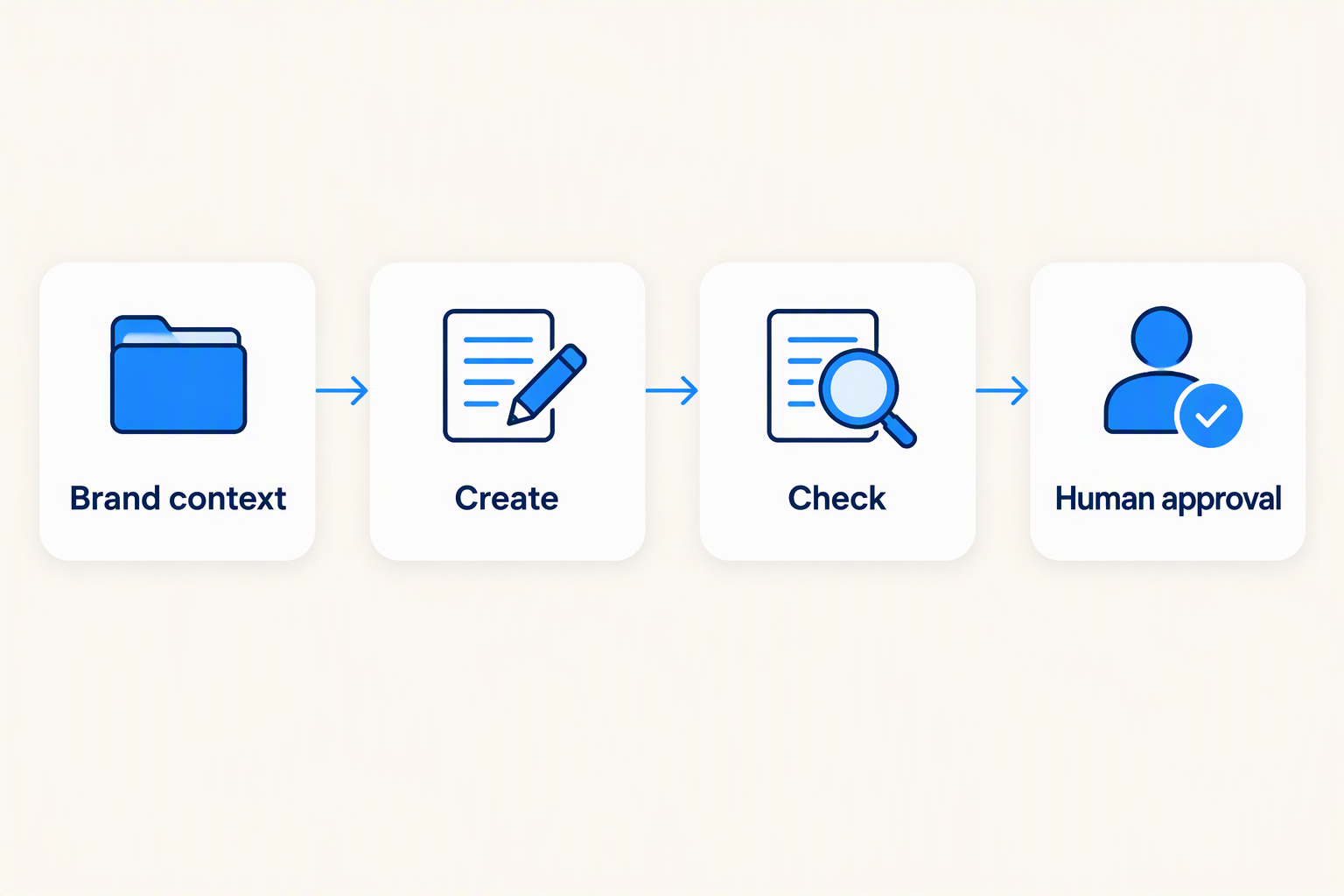
1. Turn brand guidance into usable examples
Bring together current brand guidelines, templates, approved imagery, writing examples and core messaging.
Broad instructions such as “confident”, “human” or “modern” leave room for interpretation. Show what they mean in practice:
- An email and a social post that express the same voice in different formats.
- Photography examples that demonstrate the intended subjects, lighting and treatment.
- Layout examples showing how typography and spacing work across channels.
- Examples of acceptable variation and changes that would move outside the guidelines.
Include assets from more than one campaign. This helps contributors understand what makes the brand consistent over time.
2. Give internal teams and agencies the same brief
Define the campaign objective, audience, channels, markets and core message. Identify the visual direction and any campaign-specific choices.
Make clear which elements can change and which should remain stable. A campaign may introduce a new theme while retaining established typography, image treatment and tone of voice.
Connect contributors to current source material. If guidance changes, identify affected work and communicate the update to the people producing it.
3. Review representative assets before producing every variant
Develop a small set of assets that establishes the campaign’s direction: for example, a landing-page section, an email and a social graphic.
Review them together. Do the images feel related? Does the writing sound like the same company? Are channel differences intentional?
Resolve those questions before producing dozens of variations. Early agreement on the creative direction can reduce the number of finished assets that need correction later.
4. Apply suitable checks during production
Use checks that match the requirement and the format.
Exact checks may help identify an outdated product name, incorrect colour value or missing standard text. AI-assisted checks may help flag potential differences in tone or meaning. Visual assessment may still require a designer or brand reviewer.
AI-generated statements also need factual scrutiny. NIST identifies confidently presented false or erroneous content as a generative AI risk in its Generative Artificial Intelligence Profile1. Fluent wording does not establish that a statement is supported.
Useful findings explain the concern and point to the relevant guidance or source. “This image treatment differs from the approved campaign examples” gives a contributor more direction than a generic “off-brand” label.
5. Review final assets together and in context
Content can change during design, adaptation and localisation. A crop may alter the effect of a photograph. A mobile layout may disrupt the visual hierarchy. A translation may sound much more formal than the original.
Review the actual assets in their intended formats, including any elements the software cannot inspect. Compare them with one another and with recent approved campaigns.
In regulated marketing, also assess whether qualifications and other relevant information remain readable and appropriately connected to the statements they explain.
6. Carry decisions into the next campaign
Keep the reviewed version, findings and approval decision connected. Define which later changes require another review.
When feedback reveals a recurring gap, update the relevant guidance, template or example. This makes each campaign a source of practical learning for the next one.
A more detailed discussion of review handoffs is available in this guide to structured marketing approval workflows.
Focus example: Brand consistency in a pharma campaign
Pharma illustrates why visual and editorial consistency must sit alongside substantive review.
Imagine a campaign with an email, a landing page and a set of social assets. Each uses the approved logo and colours, but the photography varies markedly and the writing moves between technical and conversational styles.
A brand review would consider whether those choices suit the intended audiences and remain recognisably connected. A separate assessment would examine the product statements, supporting evidence and presentation.
Consider this fictional source statement:
“In the studied adult population, Product X reduced the mean symptom score compared with placebo after 12 weeks.”
A campaign headline becomes:
“Product X delivers fast relief for every patient.”
The headline introduces several changes:
- “Every patient” extends the statement beyond the studied population.
- “Fast relief” changes how the timing and outcome are presented.
- The comparison and study context disappear.
These changes matter whether the headline was written by an employee, an agency or an AI tool. The example does not establish an authorised promotional claim.
A brand check might find that the sentence follows the preferred tone. Responsible specialists would still need to assess whether it is supported and appropriate for the intended audience and market.
In a pharmaceutical promotional workflow, medical, legal and regulatory review—often called MLR review—addresses questions beyond brand consistency. This MLR review guide explains the roles and workflow in more detail.
The broader lesson is that content needs to remain recognisable in its presentation and accurate in what it communicates.
How to evaluate brand compliance software
Evaluate software using your own assets, guidelines and review process. Include material from different contributors and campaigns so the test reflects the consistency problems you actually need to solve.
| Evaluation question | What to test |
|---|---|
| Can it support your visual requirements? | Use assets with an incorrect logo, typography variation and an image treatment that conflicts with your guidance. |
| Can it support your writing style? | Compare text that preserves the brand voice with text that is factually correct but tonally unsuitable. |
| What does it actually inspect? | Test text, images, documents and final layouts separately. |
| Can it distinguish variation from error? | Include an intentional channel adaptation and an approved local exception. |
| Can guidance be maintained clearly? | Update a rule and inspect how its scope and current version are handled. |
| Can contributors understand findings? | Check whether feedback identifies the issue and links to relevant guidance. |
| Can agencies participate effectively? | Test access to current material, submissions, feedback and revisions. |
| Can decisions be reconstructed? | Follow an asset through revision, review and approval. |
| What happens after approval? | Change the asset and inspect how its status and review requirements are handled. |
| Are data controls appropriate? | Review permissions, retention and permitted use of uploaded material. |
Prepare a small test set containing both correct content and known problems. Agree on the expected findings before running the test.
Include issues that require different kinds of assessment: an outdated product name, an inconsistent image style, an acceptable change in tone for a particular channel and a subtle change in claim meaning.
Assess missed issues alongside unnecessary flags. A tool that generates large amounts of vague feedback can create extra work.
The useful measure is how well it helps people produce consistent content and reach a sound review decision.
Build, buy or improve your existing workflow
Some consistency problems can be addressed by improving how teams use existing tools.
A maintained brand library, a smaller set of useful templates and a clearer briefing process may resolve recurring issues. This is particularly relevant when the main problem is that contributors cannot find or interpret current guidance.
Building an internal workflow can make sense when requirements are specialised and the organisation can maintain it. That work includes updating rules and reference material, managing integrations and access, evaluating outputs and supporting users.
Buying a platform can bring capabilities together, but it still requires configuration, ownership and testing. Software cannot decide the brand’s creative direction or resolve ambiguous guidance on its own.
Where AI tools are involved, establish which uses and data-handling arrangements are acceptable. Give employees and agencies a practical approved route for their work.
Define the controls first: current inputs, supported formats, creative boundaries, review responsibilities and decision records. Then assess which approach can maintain them reliably.
Where the EU AI Act fits
For teams using generative AI, transparency obligations are a separate consideration from brand consistency.
Article 50 distinguishes between provider obligations, including machine-readable marking of certain synthetic outputs, and deployer disclosure obligations for specified uses, including deepfakes and certain public-interest text. It does not impose a blanket requirement to label every AI-assisted marketing sentence or to use brand compliance software. Scope, roles and exceptions matter. See Article 502.
For public-interest text, the provision includes an exception involving human review or editorial control and editorial responsibility. This is not a universal exemption for AI-generated images, audio or video. The European Commission’s transparency guidance3 explains the distinctions.
Identify how AI is used, who is responsible and whether a particular output requires disclosure. A documented workflow can support that assessment; an audit trail alone does not establish legal compliance.
A 30-day pilot for brand governance
A focused pilot can show whether a proposed workflow reduces corrections and improves consistency. The following is a suggested structure, not a promised implementation timeline.
Week 1: Establish the baseline
Choose one upcoming campaign and collect examples from recent campaigns for comparison.
Map the journey from brief to approval. Record the contributors, tools, review rounds and common corrections. Include design, photography, writing style and messaging.
Measure elapsed time alongside the effort required from creators and reviewers.
Week 2: Define a manageable set of requirements
Start with recurring problems: logo use, selected layout conventions, image treatment, tone of voice, product terminology and core messaging.
Assign an owner to each requirement. Include practical examples and acceptable variations.
Where the campaign includes regulated statements, define the supporting information and specialist review needed.
Week 3: Test real work and known problems
Run representative assets through the proposed workflow. Include agency contributions and local adaptations where relevant.
Add controlled test cases: an outdated template, an inconsistent photograph, unsuitable tone, changed claim meaning and a legitimate exception.
Observe what the system catches, what it misses and how easily contributors can resolve findings.
Week 4: Review the result
Compare:
- Time from brief to approved asset.
- Creator and reviewer effort.
- Number and causes of review rounds.
- Repeated visual and editorial corrections.
- Issues missed and unnecessary flags raised.
- Consistency across the final campaign assets.
- Whether contributors used the agreed workflow.
Review the campaign against earlier work as well. A process that creates consistency within one campaign still needs to help maintain the brand across future campaigns.
Frequently asked questions
What is brand compliance software?
Brand compliance software helps organisations apply defined brand requirements to content. Capabilities can include templates, approved asset access, visual checks, writing guidance and review workflows. Check which requirements, formats and stages a particular product supports.
Is brand compliance only relevant to AI-generated content?
No. Inconsistency can arise whenever employees, agencies and local teams interpret the brand differently or use different source material. AI adds another way to create content, but the need for shared guidance applies regardless of how an asset is produced.
Does brand consistency mean every campaign must look the same?
No. Campaigns can have different creative concepts while retaining recognisable brand elements. Define what stays stable—such as typography, photographic approach or voice—and where teams can adapt the presentation.
How is brand compliance software different from a digital asset management system?
A digital asset management system primarily helps teams organise, find and distribute assets. Brand compliance capabilities help apply or assess requirements during creation and review. Products can overlap, so evaluate the actual workflow before deciding whether separate systems are needed.
Can a shared prompt library solve inconsistent AI output?
A maintained prompt library can give creators more consistent instructions and context. It still depends on current source material, correct use and assessment of the output. It also needs to sit alongside the templates, imagery and review processes used to produce final assets.
How should agencies and local teams participate?
Give them access to current guidance, practical examples and a clear way to submit work and resolve feedback. Define responsibilities for adaptations and exceptions. Review representative assets early so differences are addressed before full production.
Can software judge whether a photograph or design feels on-brand?
Some tools support visual checks, but capabilities vary. Explicit requirements may be easier to assess than nuanced creative choices. Test the software against your own examples and establish where a designer or brand reviewer must make the final judgement.
Can brand compliance software speed up approvals?
It can help identify routine issues earlier and make relevant context easier to access. The outcome depends on configuration, content quality and the review process. Measure the total effort and time needed to reach approval rather than assuming faster checks will automatically produce faster sign-off.
How Caidera supports marketing teams in regulated industries
The workflow described above brings brand guidance, content creation and review closer together. Caidera applies this approach to marketing teams in regulated industries.
Its Content Studio4 uses brand guidelines, style, campaign information and audience personas to support content creation across formats and markets. Human review and approval form part of the workflow.
The Compliance Engine5 supports checks against maintained references and configured requirements, including brand and tone rules. Findings can link to the rules behind them, and review decisions and changes are documented. Responsible reviewers assess the findings and approve the final content.
When evaluating this approach, test it against the requirements that matter to your team, including visual consistency. Confirm which asset types and elements the configured workflow can inspect and where manual review is needed.
A customer example: Bauerfeind
Caidera’s Bauerfeind case study6 describes a five-month pilot supporting a medical technology campaign for three target groups. It reports up to 97% time savings in campaign concept and strategy work and more than 80% lower content creation time per asset, with final approval retained by Medical Affairs and Legal.
These are reported results from a specific project. They illustrate potential workflow efficiencies; they do not establish the same savings or brand-consistency outcomes for every team.
For your own evaluation, bring a campaign brief, current guidelines and assets from several campaigns. Assess the consistency of the output, the usefulness of the findings and the work required to reach approval.
To explore how this workflow could support your team, book a Caidera demo using your own campaign and brand requirements.
Sources and editorial information
Sources checked on 14 October 2026. Product capabilities depend on the current offering and configuration. Customer results relate to the cited project. Practical scenarios are fictional.
1. NIST: Generative Artificial Intelligence Profile.
2. European Commission: AI Act, Article 50.
3. European Commission: Transparency obligations under Article 50.
This article provides general information, not legal advice. Assess regulatory questions against your specific content, audience and market with the appropriate specialists.