
The EU AI Act: What It Means for Life Sciences Marketing


Since August 2, 2026, the transparency obligations of EU AI Act Article 50 have applied, and enforcement will not wait for your team to catch up. If your marketing function uses AI to generate text, images, video, or chatbot conversations, several of these obligations already apply to you, whether or not anyone has checked your workflows against them yet. The fines are not symbolic: up to 15 million euros or 3 percent of worldwide annual turnover for transparency violations1. For a life sciences company already managing rules like HWG, FDA, and MLR review, a new compliance layer with real financial exposure is not something to leave for next quarter.
What this means for you: every AI-generated chatbot conversation, image, video, and public-facing text your team publishes will soon fall inside the scope of an enforceable EU law. If nobody has mapped your AI tools against Article 50 yet, that is the gap to close now, before the law takes effect on August 2.
One reassurance: the AI Act does not ban AI-generated marketing content. It regulates transparency, making sure people can tell when content is artificial. This guide explains EU AI Act marketing compliance in practical terms: what the law actually requires, what it does not require, and what your team should do now.
What Changes on August 2, 2026
The EU AI Act (Regulation (EU) 2024/1689) entered into force on August 1, 2024, but its obligations become applicable in stages. The prohibitions on certain practices have applied since February 2025, the rules for general-purpose AI models since August 2025, and the Article 50 transparency obligations since August 2, 20262.
This is where the most common misreading arises right now. The Digital Omnibus on AI (Regulation (EU) 2026/1744), published in the Official Journal on July 24, 2026 and in force since July 27, 2026, pushed the high-risk deadlines back substantially6. Article 50 was not part of that deferral. Concluding from "the AI Act has been delayed" that marketing has nothing to do would be a mistake: the transparency obligations have applied unchanged since August 2, 2026.
Article 50 is the part that matters for marketing teams. It covers four situations: AI systems that interact with people, AI-generated synthetic content, deepfakes, and AI-generated text published to inform the public.
| Date | What applies | Marketing relevance |
|---|---|---|
| Feb 2, 2025 | Prohibited AI practices | Low — bans manipulative and exploitative systems |
| Aug 2, 2025 | General-purpose AI model rules | Indirect — hits the model providers behind your tools |
| Aug 2, 2026 | Article 50 transparency obligations | Direct — this is your layer |
| Dec 2, 2026 | End of the transition for machine-readable marking under Art. 50(2) (legacy systems only) | Indirect — affects vendors whose tools were on the market before Aug 2, 2026 |
| Dec 2, 2027 | Annex III high-risk systems (deferred by the Digital Omnibus) | Low for marketing content workflows |
| Aug 2, 2028 | Annex I high-risk AI embedded in regulated products (deferred) | Low for marketing, relevant for product development |
Provider or Deployer? The Distinction That Decides Your Duties
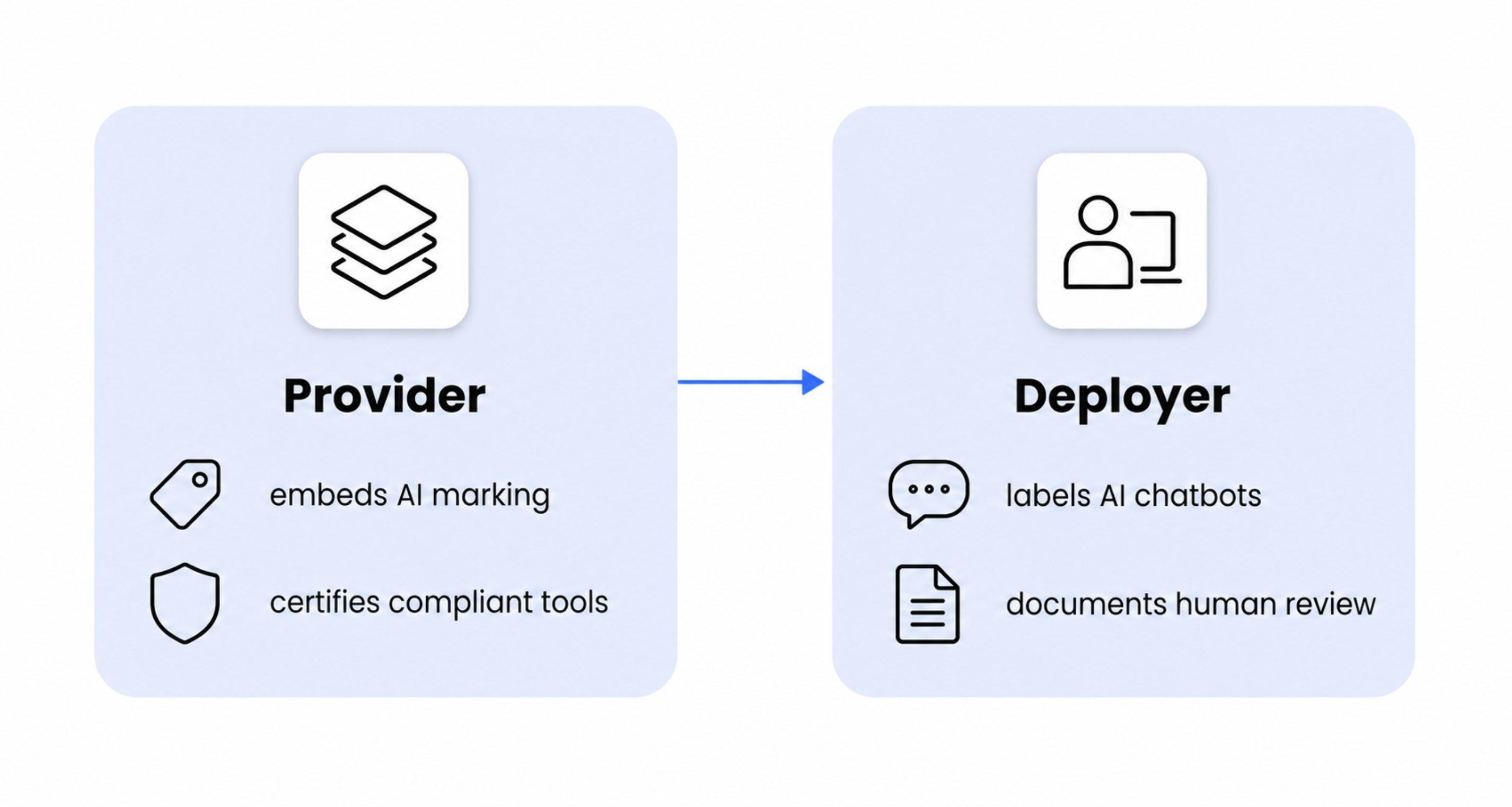
The AI Act assigns different obligations to two roles, provider vs. deployer, and most confusion about the law comes from mixing them up:
- A provider develops an AI system or places it on the market — for example, the vendor of your content generation platform.
- A deployer uses an AI system in a professional context — for example, your marketing team.
Marking AI outputs in a machine-readable format is primarily a provider obligation: Article 50(2) requires providers of generative AI systems to ensure outputs are "marked in a machine-readable format and detectable as artificially generated or manipulated"2. Your disclosure duties as a deployer are narrower, and that distinction is good news for marketing teams, provided your tools handle their side.
The Four Obligations That Can Touch Marketing
1. Chatbots and AI interactions (Article 50(1))
If your website runs an AI chatbot, people must be informed they are interacting with an AI system, "unless this is obvious" to a reasonably informed person. A clearly labeled assistant satisfies this; an AI agent posing as a human service rep does not.
So what do you do? Label every customer-facing AI interaction clearly, at the latest at the first interaction. A visible "AI assistant" tag does the job.
2. Synthetic content marking (Article 50(2))
AI-generated audio, images, video, and text must carry machine-readable marking, a provider duty. As a deployer, your practical exposure is tool selection: if your generation platform does not mark outputs, the content you publish lacks the marking the law expects.
One transition is worth knowing. For generative AI systems already on the market before August 2, 2026, the Article 50(2) marking duty applies only from December 2, 20267. Systems placed on the market after that date get no such grace period. The deployer duties under Article 50(4) are expressly outside the transition and have applied since August 2, 2026.
So what do you do? Ask every AI vendor in your stack one question: how do your outputs carry AI marking? For a legacy system, a reference to the December deadline is a correct answer, not a red flag. A shrug is a procurement red flag.
3. Deepfakes (Article 50(4))
Deployers must disclose when image, audio, or video content is a deepfake: content that resembles real persons, places, or events and would falsely appear authentic. Note what this does not cover: an obviously illustrative AI graphic in a campaign is not a deepfake. An AI-generated video of a real physician appearing to endorse your product very much is, and in life sciences it would collide with advertising law long before the AI Act.
So what do you do? If AI content depicts real people or events, disclose the manipulation visibly. Better: keep real identities out of generated content entirely.
4. AI-generated text published to inform the public (Article 50(4))
AI-written text "published with the purpose of informing the public on matters of public interest" must be disclosed as AI-generated, unless the content has undergone human review or editorial control and a person holds editorial responsibility2.
Read that exception again, because it is the single most misunderstood part of the AI Act in marketing: text that goes through genuine human review, which describes virtually every piece of life sciences content that passes MLR or an editorial process, is generally not caught by the disclosure duty. Your MLR review process is not just a regulatory burden here; it is your editorial-control evidence.
So what do you do? Keep human review in the loop for published text and document it. The audit trail you keep for compliance review doubles as your AI Act evidence.
The Code of Practice and the EU Icons
There is now practical guidance to work from. On June 10, 2026 the Commission published the Code of Practice on Transparency of AI-Generated Content, together with an official set of EU icons for labelling AI-generated content8. It followed on July 20, 2026 with adopted guidelines on the Article 50 transparency obligations9.
The Code has two sections. Section 1 addresses providers and covers marking and detection under Article 50(2) and (5). Section 2 addresses deployers and covers visible labelling of deepfakes and published text under Article 50(4) and (5). For a marketing team, Section 2 is the only part that genuinely needs reading. Chatbot labelling under Article 50(1) is not covered by the Code.
Two points matter for context. The Code and the icons are voluntary; the Article 50 obligations are not. And using an EU icon does not by itself establish legal compliance: responsibility for adequate disclosure stays with the deployer.
Where Life Sciences Teams Are Actually Exposed
Applying the four obligations to a typical pharma or medtech marketing operation, the real exposure concentrates in a few places.
- Medical information chatbots. Many life sciences websites now run AI assistants for HCP (healthcare professional) or patient questions. These sit squarely in Article 50(1): the AI nature of the interaction must be disclosed from the first message. Given the sensitivity of medical dialogue, a prominent label is both a legal and a trust requirement.
- AI-generated "patient" and "physician" imagery. Generated visuals of realistic-looking people in campaign material deserve special attention. The closer generated imagery comes to depicting seemingly real, authentic people, the closer it moves to the deepfake disclosure duty, and the more it collides with authenticity expectations in health communication.
- Disease awareness content. Unbranded educational content arguably serves "informing the public on matters of public interest," the exact category where unreviewed AI text triggers disclosure. Since disease awareness content should be going through medical review anyway, the editorial-control exemption usually applies. The risk case is fast-published, unreviewed social content.
- Translations and localizations. AI translation of approved materials is generally assistive processing of your own input rather than fresh synthetic content generation, but a translation that materially rewrites claims is new content, with both AI Act and MLR consequences.
What the AI Act Does Not Require From Marketing Teams
Overreaction wastes as much budget as ignorance. The AI Act, as it stands, does not require you to:
- Stop using AI for content creation — there is no such prohibition
- Label every AI-assisted asset visibly — assistive edits that do not substantially alter your input are explicitly out of scope
- Disclose AI involvement in internal documents, drafts, or content that never reaches the public
- Treat human-reviewed, editorially controlled text like unreviewed synthetic content
Artistic, creative, and satirical works also enjoy a lighter regime — disclosure duties apply in a way that must not spoil the work. That exception will matter more for consumer brands than for pharma, where creative deepfakes are rare for good reason.
How the AI Act Stacks With Marketing Rules
Nothing in the AI Act displaces the rules your team already works under. The stack now looks like this:
| Layer | Regulates | Example duty |
|---|---|---|
| EU AI Act | How AI-generated content is disclosed | Machine-readable marking, deepfake disclosure |
| HWG / national advertising law | What you may claim about health products | No misleading efficacy claims, Rx audience rules3 |
| FDA 21 CFR Part 202 (US) | Prescription drug advertising content | Fair balance, substantiation4 |
| MLR / internal review | Your own approval process | Medical, legal, regulatory sign-off |
An AI-generated claim that is perfectly labeled under Article 50 can still violate the HWG. And a fully compliant HWG claim can still miss AI Act marking. The layers are independent; your workflow has to satisfy all of them at once.
A Practical Compliance Checklist
- Inventory: List every AI system that touches published content — generation tools, chatbots, image models, translation engines. Most teams find more than they expect, especially tools individual marketers adopted on their own. You cannot assess obligations for systems you do not know about.
- Vendor check: Confirm each provider marks outputs in a machine-readable format (Article 50(2)) and get that in writing. A vendor attestation shifts the conversation if a regulator ever asks how your published content was marked.
- Chatbot labels: Verify every customer-facing AI interaction is disclosed at first contact, including embedded widgets from third parties, which teams routinely forget belong to their site.
- Deepfake rule: Prohibit generated depictions of real persons in your creative guidelines, or mandate disclosure where legitimately used. A one-line addition to the brand guideline prevents the entire risk category.
- Editorial control: Document human review for published text — reviewer, date, and scope — the same governance discipline behind a well-run promotional review committee. Your existing approval records likely cover this already; the task is confirming the records would actually demonstrate editorial responsibility if examined.
- Image labeling policy: Decide where visible AI labels appear on generated images, and make it a workspace default rather than a per-asset decision. Policy-level defaults survive staff turnover; per-asset judgment calls do not.
None of this requires a dedicated AI Act project. For most life sciences marketing teams it is one workshop, one vendor email round, and a handful of guideline edits, provided the tooling underneath cooperates.
Where Caidera Fits
Caidera's image workflow is built around exactly that split. Image generation triggers the provider duty under Article 50(2), and we meet it: every AI-generated image is automatically watermarked with machine-readable metadata at the moment it's created, and that marking stays intact as long as it isn't stripped downstream. What stays with you are the deployer duties under Article 50(4): visible disclosure for deepfakes and for published text without editorial control.
Article 50(2) does not require a visible label; one is permitted, but optional. We offer it anyway, because the call is yours to make. When you download an image from the Image Gallery, Library, or Zip Exports, you can add a visible "AI" label. It is applied to the downloaded file only, your stored original is never changed, and it's off by default. You control it at either level: flip the per-image checkbox yourself in the Image Gallery, or ask us to switch it on, or off, for your whole workspace.
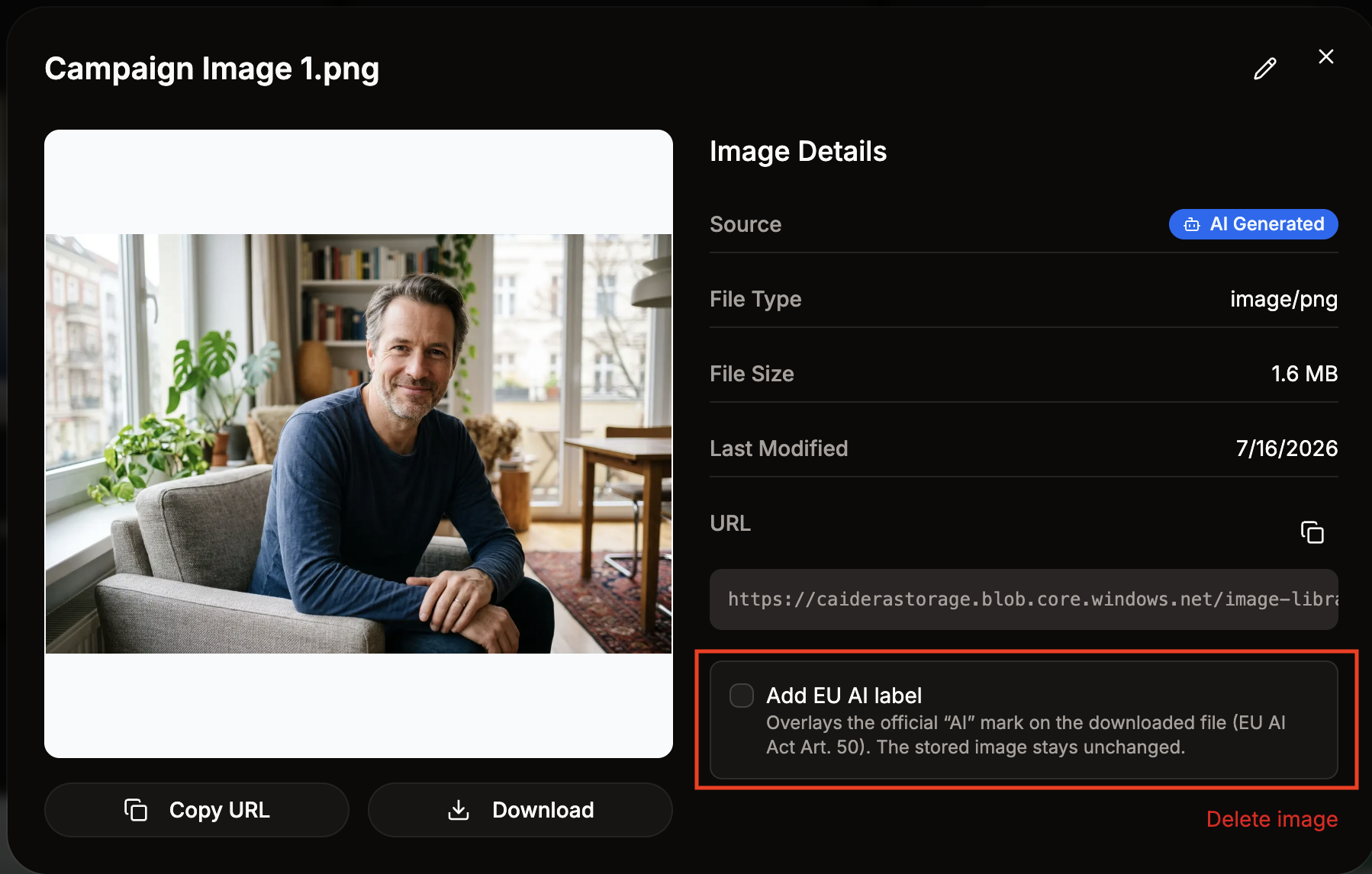
That two-level control matters because the line between "no label needed" and "this needs a visible disclosure" is a judgment call the law leaves to you, not something a blanket setting should make for you.
You can see how this works in practice on the Caidera content studio, or book a demo to walk through your specific AI-generated asset workflow. For the bigger picture on where AI fits across your marketing process, see our guide to AI-era healthcare marketing.
Frequently Asked Questions
Does the EU AI Act ban AI-generated marketing content?
No. It requires transparency about AI-generated content in defined situations: interaction disclosure, machine-readable marking, deepfake disclosure, and disclosure of unreviewed public-interest text. Creation itself is not restricted.
Do I have to label every AI-generated image?
AI-generated content disclosure isn't one-size-fits-all. Machine-readable marking of synthetic content is the provider's duty; your visible-disclosure duty as a deployer applies to deepfakes — content resembling real people, places, or events that would appear authentic. Many teams nonetheless label generated imagery by default, which is both future-proof and honest.
Our blog posts are AI-assisted but human-edited. Must we disclose that?
Text that has undergone human review or editorial control with a responsible person is exempt from the Article 50(4) text-disclosure duty. Document the review and you stand on solid ground.
Our AI tool says it is AI Act compliant. Are we covered?
Partially. A compliant tool covers the provider-side duties, machine-readable marking above all. Your deployer-side duties remain your own: deepfake disclosure and editorial control over published text. Think of it as shared responsibility, similar to cloud security models.
What are the penalties?
Non-compliance with Article 50 can result in fines of up to 15 million euros or 3 percent of total worldwide annual turnover, whichever is higher for undertakings; for SMEs and startups, the lower of the two figures applies instead of the higher1.
We are not an EU company. Does this apply to us?
Very possibly. The AI Act has extraterritorial reach: under Article 2(1)(c), it applies to providers and deployers established outside the EU where the AI system's output is used in the Union5. A US biotech running AI-generated campaigns aimed at European HCPs (healthcare professionals) or patients should treat Article 50 as applicable.
Since when do these rules apply?
Article 50 has applied since August 2, 2026. The AI Act as a whole entered into force on August 1, 2024, with obligations phased in and, following the Digital Omnibus amendment, now running to August 2, 20282, 6. One exception: machine-readable marking under Article 50(2) applies only from December 2, 2026 for systems already on the market before August 2, 20267.
Sources
1 Regulation (EU) 2024/1689 (AI Act), Article 99(4): penalties for transparency violations, including Article 50 breaches — Article 99, AI Act Explorer
2 Regulation (EU) 2024/1689, Article 50: transparency obligations, and Article 113: application dates — Article 50, AI Act Explorer; official text: EUR-Lex, Regulation (EU) 2024/1689
3 Directive 2001/83/EC (Community Code on Medicinal Products for Human Use), Title VIII/VIIIa (Arts 86–100): general advertising rules and prohibition of misleading claims — EUR-Lex, Directive 2001/83/EC; German Heilmittelwerbegesetz (HWG) §§3, 10: prescription-drug advertising restricted to professional audiences — gesetze-im-internet.de, HWG
4 21 CFR § 202.1(e)(5)(ii): fair balance requirement for prescription drug advertising; 21 CFR § 202.1(e)(1): substantiation and brief summary requirements — eCFR, 21 CFR 202.1
5 Regulation (EU) 2024/1689, Article 2(1)(c): extraterritorial scope for providers and deployers in third countries whose AI output is used in the Union — Article 2, AI Act Explorer
6 Regulation (EU) 2026/1744 (Digital Omnibus on AI) amending Regulation (EU) 2024/1689: deferral of the high-risk deadlines to December 2, 2027 (Annex III) and August 2, 2028 (Annex I); published in the Official Journal on July 24, 2026, in force since July 27, 2026 — EUR-Lex, Regulation (EU) 2026/1744
7 European Commission, FAQ on the Article 50 transparency obligations: application from August 2, 2026, the transition to December 2, 2026 for machine-readable marking of legacy systems, and the split between provider and deployer duties — Shaping Europe’s digital future, Article 50 FAQ
8 Code of Practice on Transparency of AI-Generated Content, published June 10, 2026, with Section 1 for providers and Section 2 for deployers; adherence is voluntary — European Commission, Code of Practice; EU icons for labelling, whose use is optional and does not by itself establish compliance — European Commission, EU icons
9 European Commission guidelines on the transparency obligations for providers and deployers of certain AI systems, adopted July 20, 2026 — European Commission, Article 50 guidelines
This is general guidance, not legal advice. Please assess your specific case, ideally with your own counsel.