
Germany's Healthcare Advertising Act: 10 Prohibitions with Practical Examples

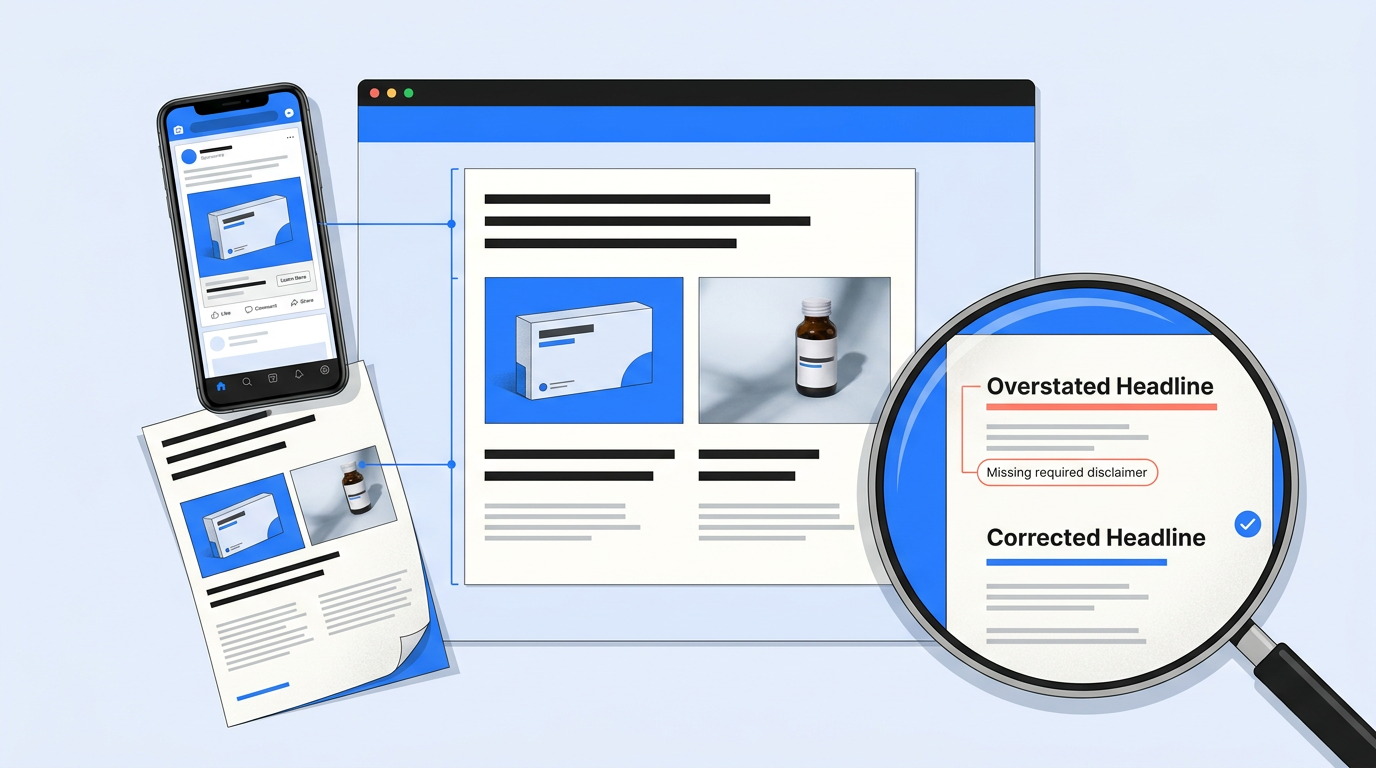
An 18-second Instagram ad, a formal legal warning and court proceedings: in 2025, the Cologne Higher Regional Court (11 September 2025, case 6 U 118/24) upheld an injunction against a pharmaceutical advertising reel. The company could no longer use the advertising in the disputed form and had to pay the costs of the appeal. The reasons included a prohibited influencer recommendation and missing warnings in the video.
The prohibitions under Germany's Healthcare Advertising Act, the Heilmittelwerbegesetz (HWG), have concrete implications for budgets and campaign planning. When advertising is prohibited, paid-for content may become unusable, additional agency hours may be needed and planned publications may be delayed. Certain violations can also attract fines of up to €50,000. This is the statutory maximum, not a standard penalty for every mistake (Section 15 HWG).
It does not take an obviously dubious promise of a cure. A shortened study quotation, a publicly posted product announcement or a voucher offered when dispensing a prescription can expose a campaign to legal challenge.
The following ten HWG prohibitions show where these risks arise in everyday marketing and what your team should change before publication. The practical examples are fictional and are supported by real court decisions.
Which HWG prohibitions apply to your campaign?
Before reviewing individual claims, answer three questions:
- What is being advertised? A medicine, a medical device or a treatment?
- Who can see the advertising? The general public or an effectively restricted audience?
- What does the finished advertisement communicate? The combined effect of text, images, sound and calls to action is decisive.
Not every HWG prohibition applies to every product category. For medical devices, for example, only certain parts of Section 11's catalogue of prohibitions apply. Article 7 of the European Medical Devices Regulation (MDR) is particularly relevant to misleading claims about their intended purpose, safety and performance.
“For healthcare professionals only” is not a blanket permission either. For prescription medicines, the law defines the permitted advertising audience more narrowly than the general category of healthcare professionals. Technical language alone does not turn a public post into advertising restricted to professionals.
This article focuses on advertising prohibitions. It only touches on the mandatory disclosures under Section 4 HWG where they are relevant to a specific example. The ten points were selected for their practical relevance to marketing teams, not to reproduce the sequence or the full scope of the statutory provisions.
Practical action: Record the product category, intended audience and channel in the brief. Verify who can actually access the final material. Reassess every adapted version before publication, because approval for a newsletter sent to doctors does not automatically cover a shortened version on Instagram.
The ten key HWG prohibitions in everyday marketing
1. Promising effects that the evidence does not support
In a nutshell: Do not promise a treatment result that the evidence does not support.
Legal basis: Section 3 HWG
Misleading pharmaceutical advertising is prohibited. This includes inaccurate claims about effects and the false impression that treatment success is guaranteed or harmful effects are ruled out.
Practical example: A team creates a leaflet for healthcare professionals promoting a painkiller. A study reports an average reduction in symptoms. The resulting headline reads: “Pain-free after the first use.”
An observed improvement has become a specific promise of success. Citing the study in the small print does not make the stronger claim accurate.
In its “Basal insulin with a weight advantage” judgment, Germany's Federal Court of Justice, the BGH, clarified that a cited study must actually support the advertised claim. Limitations affecting the strength of its findings cannot simply disappear. What evidence is sufficient depends on the claim and the circumstances (BGH, 6 February 2013, I ZR 62/11).
Practical action: Match the headline word for word against the cited evidence. State the patient population studied, the measured outcome and the timeframe. Keep every qualification that limits the finding in the final layout.
2. Promoting indications that are not authorised
In a nutshell: Do not promote a medicine for an indication outside its marketing authorisation.
Legal basis: Section 3a HWG
Medicines requiring a marketing authorisation must not be advertised without the relevant authorisation. The prohibition also covers indications and pharmaceutical forms outside an existing authorisation.
Practical example: A medicine is authorised to treat asthma. Following promising studies in chronic obstructive pulmonary disease, or COPD, the sales team adds a statement to its presentation: “Now also a treatment option for COPD.”
The new study does not extend the marketing authorisation. Even when addressing doctors, this promotional recommendation remains prohibited if the advertised indication is not authorised.
Calling something “scientific information” does not, by itself, prevent it from being classified as advertising, as the Court of Justice of the EU clarified in Case C-421/07 (Damgaard).
Practical action: Remove the recommendation for the unauthorised use from the advertising material. If you want to communicate new research findings scientifically, assess the content, purpose, audience and context during the planning stage. Link each piece of material to the version of the underlying Summary of Product Characteristics, and check affected campaigns again whenever an indication changes — an earlier internal approval is not sufficient.
3. Shortening study quotations or omitting traceable references
In a nutshell: Reproduce study findings faithfully and make every reference traceable.
Legal basis: Section 6 HWG
Advertising that uses scientific publications must provide information including the author, publication date and source. It must also be clear whether the publication concerns the advertised product itself. Requirements for faithful reproduction apply to quotations, tables and illustrations taken from other sources.
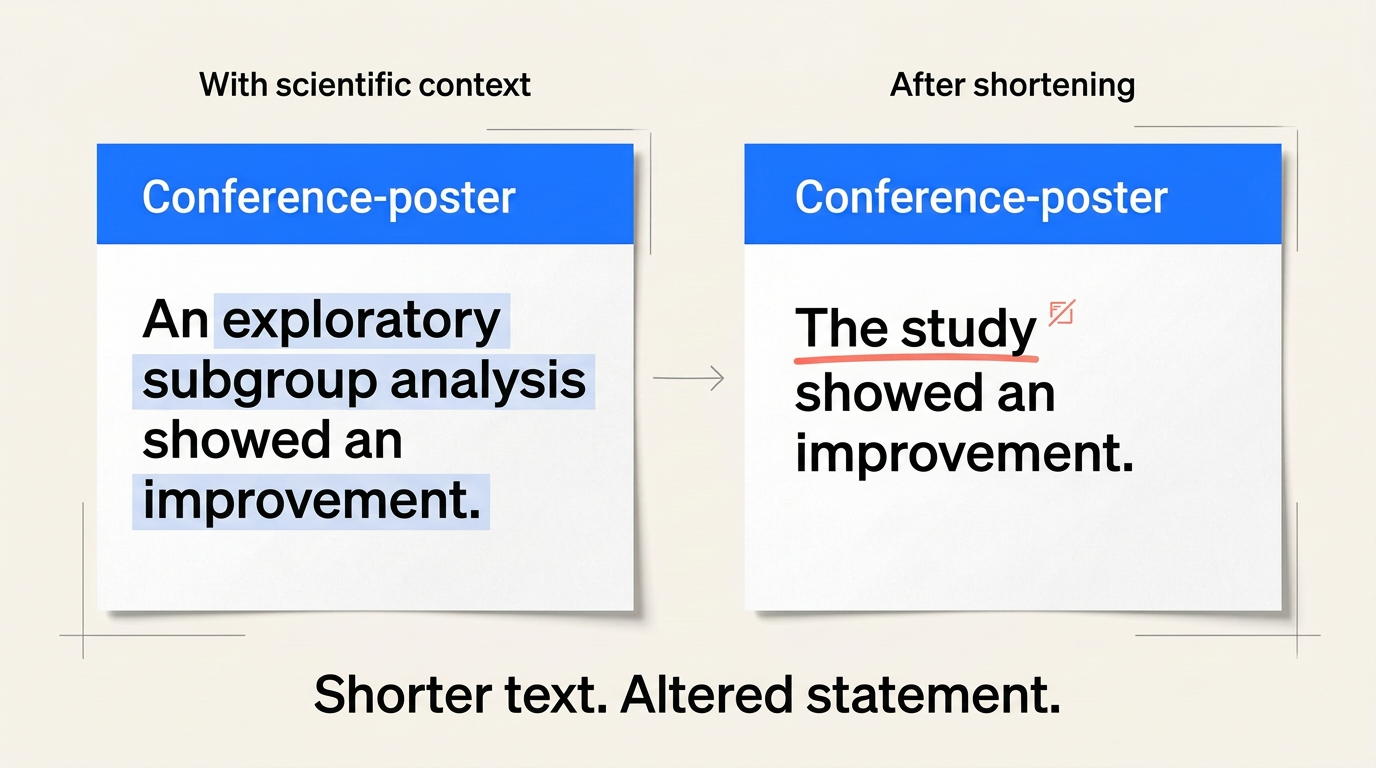
Practical example: A conference poster states: “An exploratory subgroup analysis showed an improvement.” For the final layout, the agency shortens the sentence to: “The study showed an improvement.”
The edit changes the scientific meaning. A limited finding now appears to be a general study conclusion.
Practical action: Restore the omitted context and add the full reference. Compare quotations, tables and captions with the source before approval. If the chosen format cannot present the finding accurately, replace the claim rather than shortening away its limitations. Check the finished layout too — removed footnotes and shortened captions can change the substance of previously reviewed text.
4. Influencing purchasing decisions with prohibited promotional gifts
In a nutshell: Do not use a promotional gift unless a statutory exception clearly applies.
Legal basis: Section 7 HWG
Benefits and promotional gifts are generally prohibited in product-related healthcare advertising unless a statutory exception applies. Relevant factors include the product, recipient, type of benefit and any applicable fixed-price rules.
Practical example: A pharmacy plans the offer: “Have your prescription dispensed and receive a €1 voucher for your next purchase.”
The voucher's low value does not automatically make the promotion permissible. In a 2019 case involving a bread-roll voucher, the BGH (6 June 2019, I ZR 206/17) confirmed that even small gifts accompanying the dispensing of prescription medicines subject to fixed prices can breach the relevant pricing rules.
Practical action: Remove the prescription-linked voucher offer. For every alternative, record the product, recipient, benefit and relevant pricing rule. Check the statutory exception before ordering or publishing the promotion. Do not assume that tissues or glucose sweets are automatically permissible substitutes. For gifts to healthcare professionals, Section 7 also generally requires a connection to use in medical or pharmaceutical practice.
5. Advertising remote treatment as an unrestricted substitute for an in-person visit
In a nutshell: Do not claim that remote care can replace every in-person consultation.
Legal basis: Section 9 HWG
Advertising remote treatment is permissible under certain conditions: according to generally accepted professional standards, the advertised treatment must not require in-person contact with a doctor.
Practical example: A telemedicine advertisement promises: “Every diagnosis conveniently via an app. Never sit in a waiting room again.”
The promise includes situations that may require a physical examination. Stating that qualified doctors are involved does not resolve this problem.
In 2021, the BGH (9 December 2021, I ZR 146/20) upheld a prohibition on a specific advertisement offering a comprehensive digital doctor's consultation. The advertised service and the professional standards applicable to it were decisive.
Practical action: List the use cases the service is intended to cover and the situations that require in-person contact. Obtain a medical assessment of those boundaries. State the relevant limitations in the advertisement before approving the promise.
6. Advertising prescription medicines to the public
In a nutshell: Keep prescription-medicine advertising within the legally permitted professional audience.
Legal basis: Section 10(1) HWG
Advertising for prescription medicines, often called Rx advertising, may only address the expressly listed recipients: doctors, dentists, veterinarians, pharmacists and people lawfully trading in these medicines. “Everyone working in healthcare” would be too broad.
Practical example: A pharmaceutical company publishes a LinkedIn product post containing the medicine's name, indication and a benefit claim. The post begins: “Information for oncologists.”
It is nevertheless publicly accessible. The opening line does not restrict the actual audience.
Practical action: Move product advertising behind access controls that effectively verify whether recipients belong to the legally permitted audience. Test the access route before launch. Do not rely on a general account or a simple self-declaration as the basis for access. For public channels, create a separate communication concept, and for disease awareness content, check the content, proximity to a product and links together. Our guide to MLR review explains how to organise the review process.
7. Using well-known people to recommend medicines
In a nutshell: Do not let a public profile encourage medicine consumption through a recommendation.
Legal basis: Section 11(1), sentence 1, no. 2 HWG
Certain recommendations are prohibited in advertising medicines to the public, including those by people whose public profile may encourage the consumption of medicines. This can include influencers.
Practical example: A creator begins a reel feeling unwell, takes an over-the-counter medicine and then starts the day in a good mood. The product is recommended even though nobody explicitly says, “I recommend it.”
A comparable reel was the subject of the Cologne Higher Regional Court judgment (11 September 2025, 6 U 118/24) mentioned in the introduction. The mandatory warning was also missing from the video in both displayed and spoken form. A notice in the accompanying caption or through a linked account was insufficient in that case.
Practical action: Review the person, storyboard and product connection before signing a contract. Check the complete reel, including images, actions, spoken words and captions, for an implied recommendation. Do not treat a follower threshold, advertising label or warning added afterwards as a substitute for this review. Plan for the requirements of Section 4 HWG when choosing the format.
8. Advertising cosmetic procedures with before-and-after images
In a nutshell: Do not advertise covered cosmetic procedures with comparative before-and-after images.
Legal basis: Section 11(1), sentence 3, no. 1 HWG
Public advertising for plastic-surgical procedures without medical necessity must not use comparative before-and-after depictions of their effects.
Practical example: An aesthetic clinic publishes an Instagram carousel showing a patient's nose before hyaluronic acid treatment, followed by the result. The images are authentic and the patient has consented.
Neither fact removes the advertising prohibition. In 2025, the BGH (31 July 2025, I ZR 170/24) clarified that introducing hyaluronic acid through a cannula to alter the nose or chin falls within the meaning of a plastic-surgical procedure. A scalpel is not required.
Practical action: Remove the prohibited visual comparison. Replace it with factual information about the procedure, risks and consultation. Review the complete format, including every carousel slide, video frame and caption, before publication. This is not a blanket ban on all before-and-after images in healthcare — the specific treatment and other applicable advertising rules remain decisive.
9. Using health fears as a reason to buy
In a nutshell: Do not suggest that refusing a specific product will harm someone's health.
Legal basis: Section 11(1), sentence 1, no. 7 HWG
Prohibited claims include those suggesting that someone's health will suffer if they do not use the medicine. This provision also applies correspondingly to medical devices.
Practical example: A public campaign for an over-the-counter medicine claims: “Without our daily tablet, you are putting your health at risk.”
The statement does more than provide information about a health risk. It links not using the specific product to threatened harm.
Practical action: Remove the statement that links non-use to threatened harm. Describe only the authorised, substantiated benefit. Review the music, imagery and purchase prompt together with the text, because these elements can change the overall effect of an otherwise factual sentence.
10. Advertising medicines to the public in connection with certain diseases
In a nutshell: Do not connect public medicine advertising with diseases covered by the statutory restriction.
Legal basis: Section 12 HWG and the Annex to Section 12
Public advertising for medicines must not make certain disease-related references. The list includes malignant tumours, certain infectious diseases, addictions other than nicotine dependence, and pathological complications of pregnancy, childbirth and the postpartum period.
Practical example: A manufacturer plans a public landing page promoting an over-the-counter medicine as helping to prevent malignant tumours.
“Over the counter” does not override the disease-related advertising prohibition. The product's authorisation and scientific support for the claim would also need to be checked.
Practical action: Compare every disease reference with the Annex before drafting the copy. Remove prohibited product-related references from public advertising. If you plan product-neutral education, check the content, links and surrounding campaign to confirm that it is genuinely designed as such. Different references to the Annex and specific exceptions apply to medical devices — do not transfer the medicine rules unchanged to a MedTech campaign.
What is allowed under the HWG, and what needs to change?
A study reference, mandatory warning or login may satisfy an individual review requirement. Whether the advertising is permissible depends on the complete material.
| Planned measure | Key checkpoint | Sensible change |
|---|---|---|
| “Pain-free after the first use” | Does the source support this exact outcome? | Limit the claim to the demonstrated benefit |
| Rx product post on LinkedIn | Can only legally permitted recipients access it? | Move product advertising to an effectively restricted channel |
| Study quotation without qualifications | Are meaning and context preserved? | Restore qualifications and the source reference |
| Voucher offered when dispensing a prescription | Do fixed-price rules and the prohibition on promotional gifts apply? | Remove the prescription-linked incentive |
| Influencer reel promoting a medicine | Does it contain a prohibited recommendation? | Review the concept before commissioning it |
| Before-and-after carousel for hyaluronic acid correction | Does it advertise a cosmetic procedure covered by the prohibition? | Use factual information without the prohibited visual comparison |
Each change addresses the specific issue described. Afterwards, check whether the revised version meets the other applicable requirements.
What to do if the advertising is already running?
- Stop or adjust the affected material. Pause publication where possible, or remove the disputed statement, image or incentive while the review is underway.
- Identify every affected channel and version. Check websites, social platforms, paid campaigns, email distributions, partner materials and archived or downloadable versions.
- Document the approval status. Record which version was approved, what changed, who approved it and who is responsible for the next decision.
- Preserve the review trail. Keep the relevant source materials, claims, layouts, publication records and internal decisions together.
- Obtain a legal review. Ask qualified legal counsel to assess the specific material, audience, product category and distribution context before republishing or continuing the campaign.
Environmental claims alongside HWG advertising: rules taking effect on 27 September 2026
A product advertisement can be medically accurate and still contain a prohibited environmental claim. This creates a concrete connection with the Empowering Consumers for the Green Transition Directive, known as EmpCo.
Germany's new environmental-claims rules take effect on 27 September 2026 through the Act Against Unfair Competition (UWG). They add further requirements for consumer communications to the review of health-related advertising (Third Act Amending the UWG).
(Until 26 September 2026, the new provisions described in this section are not yet applicable.)
Practical example: A public advertisement for an over-the-counter medicine combines a substantiated medical benefit with the claim “climate-neutral”. The claimed climate neutrality is based on offsetting greenhouse gas emissions.
Medical approval does not resolve the second issue. Product claims of a neutral, reduced or positive greenhouse gas impact based on offsetting will be expressly prohibited. A general claim such as “environmentally friendly” is not a safe alternative without the recognised excellent environmental performance required by law.
Practical action: Review the medical and environmental claims separately in the same finished advertisement. Identify whether the environmental benefit relates to the medicine, its packaging or another specific element. State that connection precisely. Remove a product-wide claim if the evidence only concerns the packaging.
The European Commission services' questions and answers, published in June 2026, provide additional guidance. Our article on EmpCo and sustainability claims explains which claim types are affected and how to prepare the review.
Frequently asked questions about HWG prohibitions
Is a study enough to make pharmaceutical advertising permissible?
No. The study must support the specific claim. The marketing authorisation, audience, presentation and mandatory information must also meet the applicable requirements. A substantiated medical benefit does not, for example, permit public advertising for a prescription medicine.
Is every piece of health information on social media advertising?
No. Content, purpose and context are decisive. A company post promoting product benefits and encouraging purchases or prescriptions must be assessed differently from independent factual information. The platform's name determines neither whether content is advertising nor whether it is permissible.
Does the HWG also apply to medical devices?
Yes, but not every provision applies in the same way. Check the specific provision and the relevant European requirements. Article 7 MDR is particularly relevant to misleading claims about intended purpose, safety and performance.
Does the Healthcare Advertising Act (HWG) also apply to dietary supplements?
Dietary supplements are legally classified as foodstuffs under Section 1(1) of the German Food Supplements Regulation. They are primarily subject to food law and Regulation (EC) No 1924/2006 on nutrition and health claims made on foods, not the HWG. However, the decisive factor is how the product is presented, so the specific claims and overall presentation should be reviewed before publication.
What can an HWG violation cost?
Possible consequences include the costs associated with a formal legal warning, court proceedings and revising or discontinuing a campaign. There is no reliable standard amount. The value in dispute is also neither a fine nor directly the amount payable.
For the administrative offences listed in Section 15(1), the HWG provides for fines of up to €50,000. Negligent misleading advertising can attract fines of up to €20,000. Intentional misleading advertising may also constitute a criminal offence under Section 14.
How Caidera can support review before approval
The examples show where another review may become necessary: an agency shortens a claim, the sales team adds a slide or an article for healthcare professionals becomes a public post. An earlier approval does not automatically cover the amended version.
For each advertising asset, at least the following information should therefore be available:
- Product category and the relevant current marketing authorisation or intended purpose.
- Intended recipients and actual access to the channel.
- Evidence supporting the claims and any necessary qualifications.
- Mandatory information and its implementation in the finished format.
- People responsible for reviewing and approving the specific version.
The Caidera Compliance Engine can support your team with this preliminary review. Based on the references provided and configured rules, it can flag potentially unsupported efficacy claims, possible off-label promotion or mandatory information requiring review. The platform links findings to the underlying rules and provides an audit trail documenting reviews, decisions and changes. Final professional assessment and approval remain with the responsible reviewers.
This can help marketing teams address identifiable issues earlier and submit more complete materials for Medical-Legal-Regulatory (MLR) review, the joint assessment by medical, legal and regulatory specialists.
Our guide to structured marketing approval workflows explains how to organise this workflow. To explore preliminary review for your own content, book a demo with Caidera.
Sources and legal context
Research date: 16 September 2026. Statutory provisions and court decisions are linked directly alongside the relevant statements.
The principal legal sources are Germany's Healthcare Advertising Act, Article 7 MDR and the Third Act Amending the UWG. The cited court decisions concern specific advertising materials; their applicability to other situations depends on the facts of each case.
This is general information, not legal advice. Please review your specific case, ideally with your own legal counsel.